The recession fashion trend is the shift towards affordable, minimalist, and versatile clothing that consumers adopt during periods of economic uncertainty. It is not a single aesthetic but a collective behavioural response, where wardrobes contract in cost and expand in function. The term sits alongside the more established concept of “recession dressing,” a pattern observed across multiple downturns from the 1970s to the 2008 financial crisis. What makes the current wave distinct is the role of social media in amplifying it, the secondhand market’s rapid growth, and a generation of shoppers who treat thrift as a style statement rather than a compromise.
What is the recession fashion trend and what defines it?
Recession dressing centres on four qualities: affordability, versatility, longevity, and restraint. Consumers move away from fast fashion and bold statement pieces, gravitating instead towards neutral colours, longer hemlines, and garments that work across multiple settings. The contrast with boom-time fashion is stark. During economic expansions, maximalist trends dominate: bright colours, micro hemlines, and conspicuous logos. When confidence drops, so does the hemline.
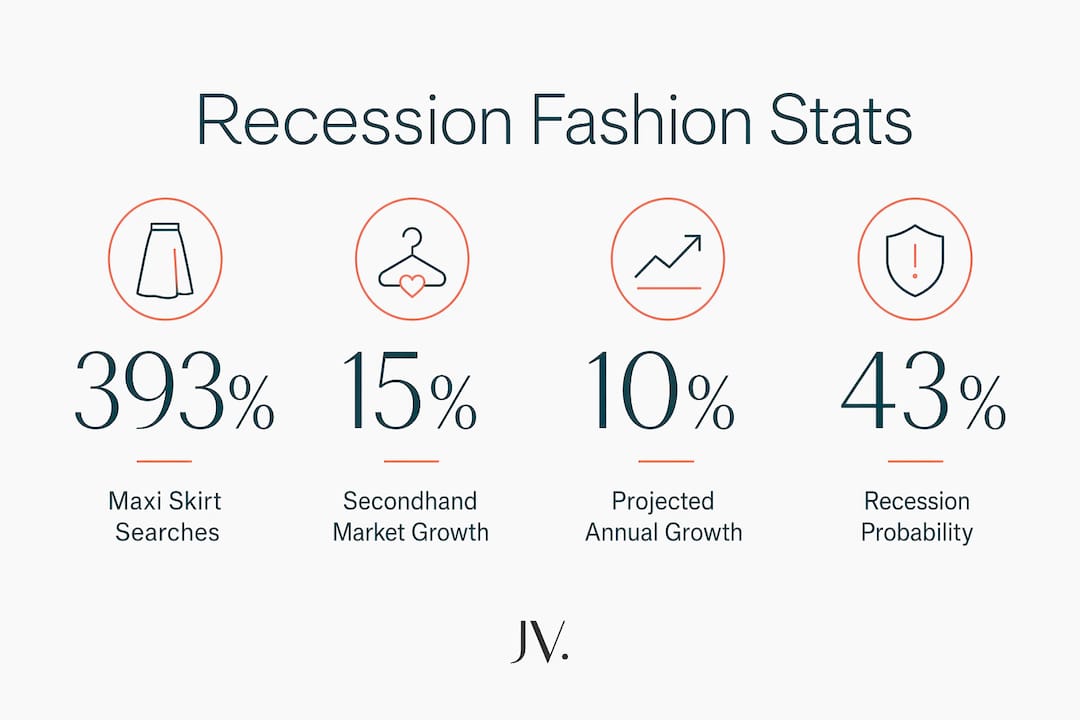
Search data from early 2025 captures this shift precisely. Maxi skirt searches surged 393%, a figure that reflects a consumer pivot towards conservative silhouettes. That single statistic tells you more about collective mood than any runway report. The pleated maxi skirt became one of the most searched wardrobe items of the year, sitting at the intersection of modesty, practicality, and quiet elegance.
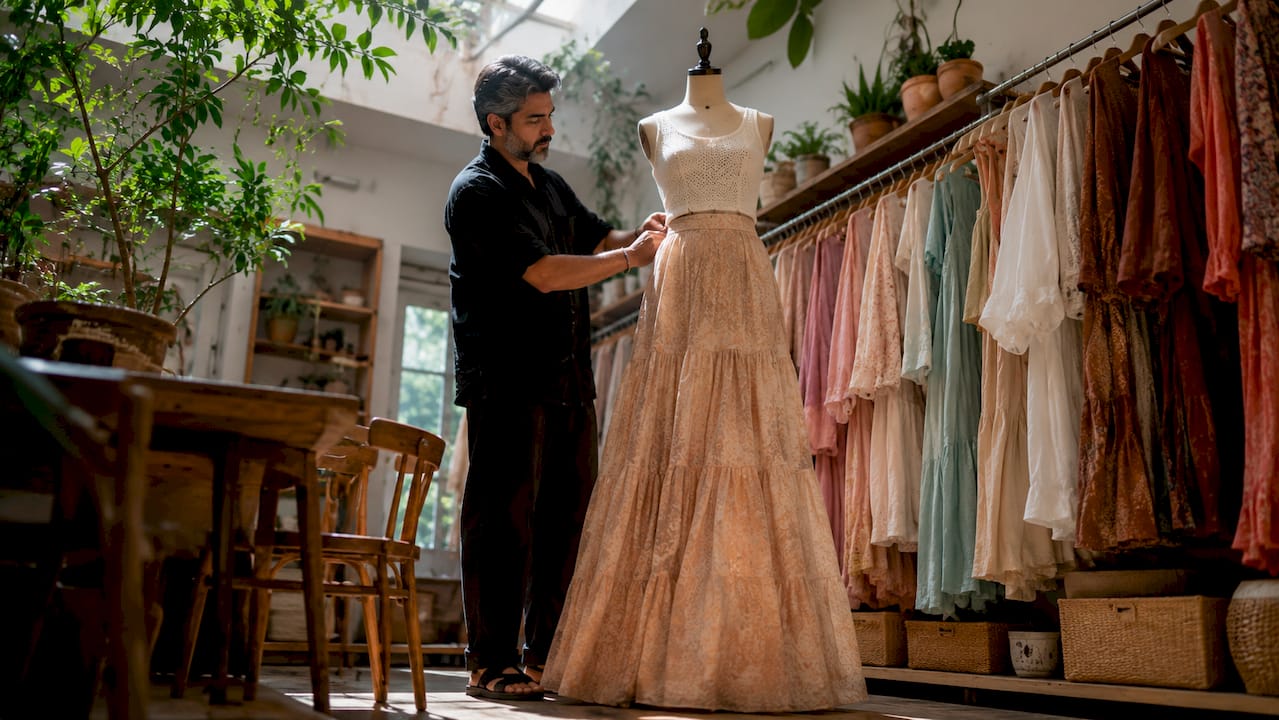
Muted tones such as camel, stone, navy, and charcoal replace the dopamine dressing of previous seasons. Business casual styles see renewed demand as workers seek garments that signal professionalism without requiring a full corporate wardrobe. Minimalist dressing becomes the default, not because it is fashionable, but because it is functional.
Key characteristics of recession fashion include:
- Longer hemlines: Midi and maxi lengths dominate over mini cuts.
- Neutral colour palettes: Stone, beige, navy, and grey replace bold or seasonal colours.
- Versatile silhouettes: Pieces that transition from work to weekend without effort.
- Durable fabrics: Consumers prioritise quality over novelty.
- Reduced logo visibility: Quiet luxury replaces conspicuous branding.
How does vintage and secondhand fashion contribute to recession style?
The secondhand market grew 15% in 2024, with annual growth of around 10% expected through 2029. That trajectory is not driven primarily by sustainability ethics. Affordability and individuality are the real engines. Shoppers want unique pieces at lower prices, and vintage delivers both.
The eras attracting the most attention are Y2K (late 1990s to early 2000s), 90s minimalism, and oversized denim from the mid-1980s. Each offers a distinct visual identity that fast fashion cannot replicate at scale. A vintage Levi’s jacket or a 90s slip dress carries a character that a high-street copy simply does not. For eco-friendly fashion choices, vintage also reduces demand for new production, which appeals to shoppers who care about environmental impact alongside value.
Shopping vintage effectively requires a different approach from browsing a standard retail site. Generic searches return too much noise. The most effective method is to search by era, designer detail, or specific garment type rather than broad categories. When buying vintage denim, check actual measurements rather than relying on tag sizes. Sizing standards have shifted significantly across decades, and a tag marked “12” from 1985 will not match a modern size 12.
- Search by era first (e.g., “90s minimalism” or “Y2K knitwear”) to narrow results.
- Filter by specific designer details or fabric composition for quality assurance.
- Always request or check garment measurements before purchasing online.
- Prioritise natural fibres such as wool, cotton, and silk for longevity.
- Look for signs of wear at collars, cuffs, and seams before committing.
Pro Tip: When thrifting online via platforms like Depop or Vinted, save searches for specific brand names combined with era keywords. You will surface better quality at lower prices than searching generic terms like “vintage dress.”
What do experts say about recession fashion and economic signalling?
Fashion industry analyst Vincent Quan observes that consumers trade down to value-priced apparel during downturns, choosing minimalistic styles that contrast sharply with the maximalism of boom periods. This is not simply about spending less. It reflects a recalibration of what clothing is for. Garments become tools for projecting stability rather than expressions of abundance.
Image consultant Monica Barnett takes this further. She argues that elegantly minimal dressing signals stability and executive presence. Choosing a well-cut blazer over a trend-led piece is a deliberate professional strategy, not a concession to a tighter budget. The wardrobe becomes a communication device, telling colleagues, clients, and employers that you are composed and considered.
“Recession dressing is not about looking poor. It is about looking permanent.” This captures the core logic: the goal is to project durability and calm, not austerity.
The internet adds a layer of complexity to this picture. Fashion recession indicators are frequently applied retroactively by social media culture rather than identified in real time. The “lipstick index,” the hemline theory, and the rise of quiet luxury are all patterns that commentators notice after the fact and then frame as predictive. Cultural analysts point out that these narratives reflect emotional self-expression more than reliable economic forecasting. Shoppers are not consciously signalling recession. They are responding to anxiety, and the aesthetic patterns emerge from that response collectively.
Economic context reinforces the behavioural shift. A 43% probability of US recession was estimated in 2025, prompting a visible consumer pivot towards versatile, business casual wardrobes. That probability figure shaped purchasing decisions even among shoppers who never read an economic report.
How can you build a recession-ready wardrobe?
Effective wardrobe curation starts with an audit of what you already own, not a shopping trip. Pull everything out, assess fit, condition, and frequency of use, and identify genuine gaps. Most wardrobes contain more than enough raw material for a recession-ready rotation. The problem is usually disorganisation rather than shortage.
Once you know what you have, the principle of versatile key pieces applies directly. A well-cut blazer, a midi dress in a neutral tone, and a pair of tailored trousers will cover more occasions than a wardrobe full of trend-specific items. Cost-per-wear is the metric that matters. A £15 going-out top worn twice costs more per wear than a £60 midi dress worn forty times.
Replacing worn items with intention is the discipline that separates a recession-ready wardrobe from a merely cheap one. Before buying anything new, ask whether it works with at least three existing pieces. If it does not, it is not a wardrobe investment. It is an impulse purchase dressed up as practicality.
- Audit first: Assess every item for fit, condition, and versatility before buying anything new.
- Invest in blazers and midi dresses: These versatile dress styles work across work, social, and casual settings.
- Choose neutral base colours: Camel, navy, stone, and grey mix with almost everything.
- Add vintage selectively: One or two vintage pieces per outfit create individuality without sacrificing cohesion.
- Avoid impulse buys: Apply the three-outfit rule before any purchase.
Pro Tip: Photograph your existing wardrobe and organise images by category on your phone. When you are tempted to buy something new, scroll through your catalogue first. You will often find you already own a better version.
How does recession dressing affect shopping behaviour and retail?
Consumer search patterns in 2025 confirm a clear shift towards minimalist and business casual styles. Retailers who recognised this early adapted their collections accordingly, promoting versatile, neutral, and classic pieces over seasonal trend items. Those who continued to push maximalist or fast-fashion models saw weaker engagement.
The secondhand and vintage sectors gained ground against traditional retail as a direct result of this shift. Shoppers seeking value and individuality found both in resale markets, which traditional retailers cannot easily replicate. The response from mainstream retail has been to introduce more affordable, versatile lines and, in some cases, to partner with resale platforms directly.
| Shopping behaviour | Economic boom | Economic downturn |
|---|---|---|
| Colour preference | Bold, seasonal | Neutral, timeless |
| Hemline preference | Mini, statement | Midi, maxi |
| Brand visibility | Logo-forward | Quiet, understated |
| Purchase motivation | Trend participation | Value and versatility |
| Market growth area | Fast fashion | Secondhand and vintage |
The shift is not temporary. Consumers who discover the value of versatile casual dresses and secondhand shopping during a downturn rarely abandon those habits entirely when conditions improve. Recession dressing reshapes long-term purchasing behaviour, not just seasonal choices.
Key takeaways
Recession fashion is a deliberate shift to affordable, versatile, and minimalist dressing that reflects economic anxiety and reshapes long-term wardrobe habits.
| Point | Details |
|---|---|
| Core definition | Recession fashion prioritises affordability, versatility, and longevity over trend-led or logo-heavy pieces. |
| Search signals confirm the shift | Maxi skirt searches rose 393% in early 2025, reflecting a consumer move towards conservative silhouettes. |
| Secondhand market is growing fast | The resale market grew 15% in 2024, driven by affordability and individuality rather than sustainability alone. |
| Audit before you buy | Wardrobe curation starts with assessing what you own, not acquiring new staples impulsively. |
| Dressing signals stability | Minimal, well-cut clothing communicates professional composure during economic uncertainty. |
Why recession fashion is a mindset, not a sacrifice
I have watched the conversation around recession dressing shift considerably over the past few years. When I first started paying close attention to how economic conditions shape style, the dominant narrative was one of deprivation: you dress down because you cannot afford to dress up. That framing is wrong, and I think it does real damage to how people approach their wardrobes.
The shoppers I find most compelling are not the ones who spend the most. They are the ones who have developed a clear point of view about what they wear and why. Recession fashion, at its best, forces exactly that kind of clarity. When you cannot buy everything, you choose carefully. That discipline produces wardrobes that are more coherent, more personal, and frankly more stylish than anything assembled through uncritical trend-following.
Combining a vintage piece with a modern minimalist base is one of the most effective styling strategies I know. A 90s-era structured jacket over a clean midi dress creates a look that no algorithm can replicate, because it reflects actual taste rather than a trend cycle. That is the real opportunity in recession dressing: not spending less, but choosing better.
The emotional dimension matters too. Clothing is one of the few areas where people exercise genuine creative control over how they present themselves to the world. Treating that as a strategic act rather than a reactive one changes everything. You stop chasing trends and start building something that actually represents you.
— Mykola
Jvwear’s picks for a recession-ready wardrobe
Recession style does not mean settling for less. It means choosing pieces that work harder.
Jvwear’s collection is built around exactly the kind of versatile, well-cut pieces that recession dressing demands. The cardigan range offers layering options that move from office to weekend without effort, in neutral tones that anchor any outfit. For a complete look, the Solvra two-piece midi dress set combines a button-front cardigan with a midi silhouette, delivering the versatility and quiet elegance that recession style is built on. Free UK shipping and 30-day returns mean you can shop with confidence, not pressure.
FAQ
What is the recession fashion trend in simple terms?
The recession fashion trend is the shift towards affordable, minimalist, and versatile clothing during periods of economic uncertainty. Consumers prioritise value, longevity, and multi-use garments over trend-led or logo-heavy pieces.
Does recession fashion mean wearing cheap clothes?
Recession fashion is not about cheap clothing. It is about maximising cost-per-wear by choosing well-made, versatile pieces that work across multiple settings and seasons.
Why are maxi skirts linked to recession dressing?
Longer hemlines have historically tracked with periods of economic caution. Search interest in maxi skirts surged 393% in early 2025, reflecting a consumer shift towards conservative, budget-conscious silhouettes.
Is the secondhand market growing because of recession fashion?
The secondhand market grew 15% in 2024, with continued annual growth expected through 2029. Affordability and individuality are the primary drivers, not sustainability alone.
How do I start building a recession-ready wardrobe?
Start by auditing your existing wardrobe before buying anything new. Identify gaps, prioritise versatile neutral pieces such as blazers and midi dresses, and apply the three-outfit rule to every potential purchase.