Minimalist dressing gets a bad reputation. A lot of women hear the word “minimalist” and picture a bland wardrobe of grey basics with no personality. But that’s not how minimalist dressing works at all. At its core, it’s a practical system for reducing the noise in your wardrobe so that getting dressed feels easier, faster, and genuinely more enjoyable. Rather than restricting your style, it actually sharpens it. This guide breaks down the logic behind it, how to build it from scratch, and how to keep it working as your life changes.
Table of Contents
- Key takeaways
- How minimalist dressing works: the capsule concept explained
- Core principles that make minimalism actually work
- Building your minimalist wardrobe step by step
- Chic minimalist outfit ideas that actually work
- Maintaining your wardrobe as life changes
- My take on minimalist dressing and real freedom
- Build your minimalist wardrobe with Jvwear
- FAQ
Key takeaways
| Point | Details |
|---|---|
| Less really is more | A curated wardrobe of 25 to 40 pieces can outperform a stuffed wardrobe for both versatility and ease. |
| Fit comes before quantity | One perfectly fitted piece adds more to your wardrobe than three items that don’t quite work. |
| Start with what you own | Building from clothes you already love prevents wasted spending and creates a wardrobe that reflects real life. |
| Outfit planning builds confidence | Pre-planning 7 to 10 looks from your capsule removes daily guesswork and makes mornings feel effortless. |
| Minimalism evolves with you | Your wardrobe should shift gradually as your lifestyle, body, and tastes change over time. |
How minimalist dressing works: the capsule concept explained
The term “minimalist wardrobe explained” often gets tangled up with aesthetics, but the function matters far more than the look. Minimalist dressing is a method of curating your clothes so every item earns its place. Nothing hangs there unused. Nothing requires a specific other outfit to work.
The capsule wardrobe concept sits at the heart of this approach. A functional capsule typically holds 25 to 40 pieces, including tops, bottoms, outerwear, shoes, and a few accessories. That number isn’t a rule but a useful guide. The actual goal is cohesion: every item you own should pair naturally with several others, creating combinations rather than isolated outfits.
Why does this matter for daily life? Because choosing what to wear is a decision, and decisions cost energy. When your wardrobe is full of pieces that don’t work together or that you rarely wear, you spend real mental effort sorting through the noise. That fatigue accumulates. A minimalist wardrobe removes that low-stakes stress by making every option a good one.
The three foundations of a functional minimalist wardrobe are:
- Fit. A piece that fits your body well looks intentional, regardless of its price point. Fit is non-negotiable.
- Fabric and quality. Natural fabrics like cotton, linen, and wool tend to photograph better, feel better, and last longer.
- Colour palette. Sticking to a cohesive palette (usually neutrals anchored by one or two accent colours) means everything coordinates automatically.
Pro Tip: Before defining your colour palette, spend five minutes looking at your five most-worn outfits. The colours you keep reaching for are already your palette.
Core principles that make minimalism actually work
Understanding minimalist style isn’t just about knowing what to buy. It’s about how you approach getting dressed. These principles are what separate a wardrobe that looks pulled-together from one that just looks sparse.
-
Prioritise fit above everything else. Well-fitting pieces in neutral colours are the engine of a capsule wardrobe. A tailored pair of trousers or a well-cut dress can carry three different looks without any effort. If something doesn’t fit, no amount of styling will fully rescue it.
-
Build around neutrals, then add character. Neutrals (white, black, camel, navy, grey, cream) serve as the foundation because they pair with almost anything. Once your neutrals are sorted, you can introduce one or two colours or prints that reflect your personality. This prevents the wardrobe from feeling like a uniform while keeping it cohesive.
-
Use layering as your variety tool. A white shirt worn alone, under a blazer, or under a knit creates three distinct looks without adding three items to your wardrobe. Layering is how you get more from less, and it’s one of the most underused minimalist fashion tips.
-
Start with what you already wear. Building from real clothes you already love means your wardrobe fits your actual life rather than an imagined version of it. Shopping first is one of the most common mistakes.
-
Avoid the numbers trap. Aiming for exactly 33 pieces because a blog said so misses the point. A wardrobe with 45 versatile, well-loved pieces beats a wardrobe of 30 items that don’t fully serve you.
Pro Tip: If an item only works with one other thing in your wardrobe, it doesn’t belong in a capsule. Every piece should coordinate with at least three others.
Building your minimalist wardrobe step by step
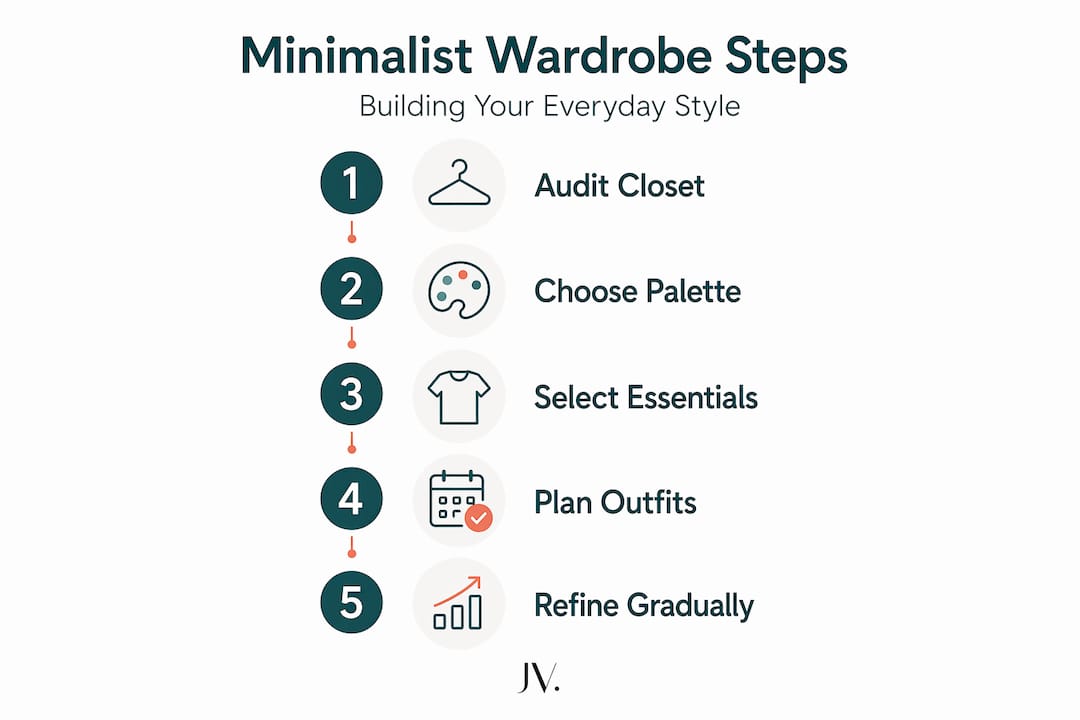
The most practical entry point into minimalist dressing is a wardrobe audit. Not a dramatic clear-out, but an honest one. Here’s how to approach it:
- Pull everything out. Lay it on your bed. See what you actually own.
- Sort by wear frequency. What do you reach for most weeks? What hasn’t moved in six months?
- Remove what doesn’t match. If a piece doesn’t pair with at least three other items you own, set it aside.
- Check for fit. Be honest. If it hasn’t fitted properly in over a year, it’s not serving you.
- Identify genuine gaps. Only after this audit do you start thinking about what to add.
Once your edit is done, pre-plan 7 to 10 outfits from what remains. This step is transformative. Many women discover they already have more variety than they thought. It also reveals real gaps, which are the only things worth shopping for.
Building in categories

A module approach makes this manageable. Rather than thinking “I need a whole new wardrobe,” think in blocks:
| Category | Suggested range | Examples |
|---|---|---|
| Tops | 8 to 10 pieces | White shirt, ribbed vest, fitted turtleneck, linen blouse |
| Bottoms | 5 to 7 pieces | Straight-leg jeans, tailored trousers, midi skirt |
| Dresses | 3 to 5 pieces | Midi dress, shirt dress, little black dress |
| Outerwear | 2 to 3 pieces | Trench coat, casual jacket, knitwear |
| Shoes | 3 to 5 pairs | White trainers, loafers, block heels, sandals |
Fill gaps gradually as your budget allows. There’s no deadline. Slow, intentional additions beat a panicked shopping trip every time.
Chic minimalist outfit ideas that actually work
One of the genuine benefits of minimalist wardrobe building is that it forces you to think about outfits, not just individual items. The result is a wardrobe where you can get dressed in under five minutes and still look considered.
A few versatile building blocks are worth knowing:
-
The midi dress. Fashion editors consistently champion the perfectly cut midi dress as one of the most efficient wardrobe pieces. Wear it alone in summer, layer it over a turtleneck in winter, or belt it at the waist for a more structured silhouette. You can explore effortless midi styling for more ideas on making it work across seasons.
-
The fitted blazer. Thrown over a simple vest and wide-leg trousers, it reads as office-ready. Worn open over a slip dress with trainers, it becomes weekend-appropriate. One piece, multiple directions.
-
Classic straight-leg jeans. Arguably the hardest-working item in any capsule. They pair with everything: relaxed shirts for casual days, silk tops for evenings, oversized knits for weekends.
-
A quality white or cream top. Simple, yes. But in a good fabric with a clean cut, it’s the foundation of at least five different looks.
Accessories do the work of personalising a minimal wardrobe without cluttering it. A single well-chosen necklace, a structured bag, or a silk scarf can shift the mood of an outfit entirely. If you enjoy jewellery layering, knowing how to layer pearl necklaces is a genuinely useful skill for adding texture to simple outfits without going overboard. For more wardrobe inspiration, the Parisian dressing approach offers a masterclass in using restraint as a style tool.
Maintaining your wardrobe as life changes
A capsule wardrobe isn’t a project you complete once and forget. It’s an ongoing relationship with your clothes. The benefits of minimalism extend beyond the initial edit: over time, buying fewer better pieces costs less per wear than constantly buying cheaper items that don’t last.
Here’s how the approach shifts across different situations:
| Situation | Reactive approach | Minimalist approach |
|---|---|---|
| Seasonal change | Buy new pieces each season | Rotate stored items, add one or two targeted updates |
| Body changes | Replace entire wardrobe | Reassess fit, adjust by category, keep what works |
| New job or lifestyle | Panic-buy for the new context | Audit existing wardrobe first, identify genuine gaps |
| Impulse purchase temptation | Buy because it’s on sale | Ask: does this work with at least three things I own? |
Seasonal rotation is also worth doing practically. Storing off-season clothes in vacuum bags or under-bed boxes reduces visual clutter and makes your daily wardrobe easier to navigate. The goal is clarity: when you open your wardrobe, you should see options, not obstacles.
My take on minimalist dressing and real freedom
I’ve seen a lot of women approach minimalist dressing with a kind of reluctant acceptance, as though they’re giving something up. In my experience, the opposite is true.
When I first stopped treating my wardrobe as a collection and started treating it as a toolkit, the mornings changed completely. I wasn’t searching for things that worked. Everything worked. That shift in cognitive load is genuinely underestimated.
What I’ve learned is that the creativity argument against minimalism is completely backwards. Constraints push you to be more creative, not less. When you can’t fall back on buying something new, you actually start styling what you have. You discover combinations you’d never considered. The wardrobe becomes more expressive, not less.
The women I see who dress with the most effortless style rarely have wardrobes bursting with options. They have wardrobes with the right options. That’s the whole point.
— Mykola
Build your minimalist wardrobe with Jvwear
If your audit has revealed a few genuine gaps, filling them thoughtfully is the right next step. Jvwear’s curated collection is built around exactly the kind of versatile, everyday pieces that a minimalist wardrobe relies on. The Elowen gingham midi sundress is the kind of piece that earns its place immediately: polished enough for social occasions, relaxed enough for day-to-day wear, and practical with its pockets. For tops that form the backbone of multiple outfits, the Jvwear tops collection offers clean, well-cut options that sit naturally in any capsule wardrobe. Free UK shipping and 30-day hassle-free returns make it easy to shop with confidence, especially when you’re being intentional about every addition.
FAQ
What exactly is a minimalist wardrobe?
A minimalist wardrobe is a curated collection of clothing where every item fits well, serves a real purpose, and pairs with multiple other pieces. Most functional capsules contain between 25 and 40 items.
How many items should a capsule wardrobe have?
There is no fixed number, but 25 to 40 pieces is a commonly recommended range for daily versatility. The actual count matters less than whether each item genuinely works with the others.
Does minimalist dressing mean giving up personal style?
Not at all. Minimalist dressing sharpens your personal style by removing pieces that don’t reflect it. Accessories, one or two accent colours, and considered layering all allow for real self-expression within a minimal framework.
Where do I start if my wardrobe feels overwhelming?
Start with a wear-frequency audit rather than a full clear-out. Pull everything out, identify what you actually reach for, and build your capsule from those pieces first. Only shop for genuine gaps after that step.
Can I build a minimalist wardrobe on a budget?
Yes. Buying fewer, better pieces over time is more cost-effective than regularly restocking cheaper items that wear out quickly. The transition doesn’t need to happen all at once.