“Dressed down” is defined as wearing informal or casual clothing in a situation where formal attire would normally be expected. The phrase carries a second, entirely separate meaning: to receive a stern reprimand from an authority figure. Understanding which meaning applies depends entirely on context, and confusing the two can lead to genuine misunderstandings. This guide covers both definitions, their origins, and practical advice on how to dress down appropriately for work, social occasions, and everyday styling.
What does “dressed down” mean in fashion?
Dressing down means choosing informal clothes over formal ones, typically in a setting where smarter attire would otherwise be the norm. The most familiar example is the workplace. Offices across the UK and beyond have adopted “dress down Fridays” or “casual Fridays” as a standing policy, allowing employees to swap suits and formal blouses for jeans, trainers, and relaxed tops at the end of the working week. This shift reflects a broader cultural move toward flexibility in professional environments, where business casual has steadily replaced rigid formality as the accepted standard.

Dressing down is not limited to offices. Social occasions such as garden parties, informal dinners, and daytime events often call for a relaxed approach to attire. Wearing a structured blazer to a casual Sunday lunch, for instance, would feel overdressed. Knowing how to pitch your outfit to the occasion is the core skill behind dressing casually explained well.
The phrase also applies to a specific styling technique. Pairing formal items with casual pieces creates a more relaxed look without abandoning sophistication entirely. A tailored midi dress worn with white trainers and a denim jacket is dressed down. A sharp blazer thrown over a plain T-shirt and wide-leg trousers is dressed down. This approach increases wardrobe versatility considerably, letting one garment work across multiple occasions.
- Swap formal heels for clean white trainers or loafers to instantly relax an outfit
- Layer a casual cardigan or denim jacket over a structured dress
- Choose relaxed accessories such as canvas totes or woven bags instead of structured leather handbags
- Opt for natural fabrics like linen or cotton to signal informality through texture as well as silhouette
- Leave a shirt collar open rather than buttoning to the top
Pro Tip: When dressing down a formal piece, change one element at a time. Swap the shoes first, then reassess. Changing everything at once often results in an outfit that loses its shape and intention entirely.
What does it mean to be “dressed down” as a reprimand?
The second meaning of “dressed down” has nothing to do with clothing. A dressing-down is a severe reprimand, typically delivered by someone in authority to a person who has behaved badly or made a serious error. A manager who calls an employee into their office to criticise their conduct gives them a dressing-down. A parent who scolds a teenager firmly is dressing them down.
This usage dates back to at least 1823 and originates in nautical language, where officers would reprimand sailors in front of the crew. Despite those archaic roots, the expression remains common in modern British English, particularly in formal and professional contexts. Newspapers, novels, and workplace conversations all use it freely.
The grammatical form matters here. Consider these distinctions:
- “She received a dressing-down from her supervisor” refers to a reprimand (noun form)
- “He was dressed down in front of the entire team” also refers to a reprimand (passive verb form)
- “They dressed down for the office party” refers to casual clothing (active verb form)
“The noun form ‘a dressing-down’ almost always signals the reprimand meaning, while the active verb phrase ‘dress down’ most commonly refers to clothing choices.” — English Word Champs
The reprimand sense carries a tone of authority and consequence. It implies the criticism was serious, not a passing comment. Saying someone “got a dressing-down” suggests the exchange was pointed and uncomfortable, not merely a gentle note.
How to tell which meaning of “dressed down” is intended
“Dress down” is a homonymic phrase whose meaning depends entirely on the surrounding context. Fortunately, the two meanings rarely cause genuine confusion in practice because the sentence structure signals the intent clearly.
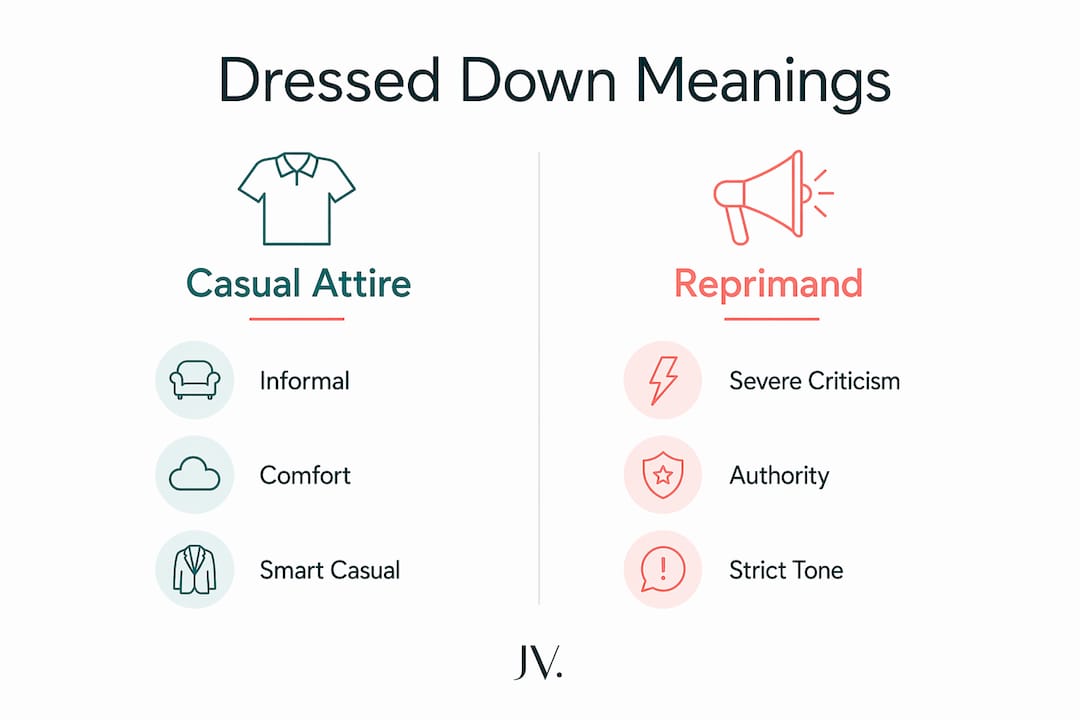
The most reliable guide is grammatical form. The noun phrase “a dressing-down” almost exclusively refers to criticism. The active construction “dress down” or “dressed down for” almost always refers to clothing. Contextual cues like “dress-down day” signal casual attire, while “he received a dressing-down” signals reprimand without any ambiguity.
| Feature | Casual attire meaning | Reprimand meaning |
|---|---|---|
| Grammatical form | Active verb: “dress down for…” | Noun or passive: “a dressing-down” |
| Typical context | Workplace policy, social occasion, styling | Professional discipline, parental correction |
| Tone | Relaxed, positive | Serious, authoritative |
| Common phrases | “Dress-down Friday”, “dressed down the outfit” | “Received a dressing-down”, “dressed down by the boss” |
| Who uses it | Anyone discussing attire | Authority figures, journalists, writers |
When writing or speaking, providing contextual cues removes all ambiguity. “We have a dress-down policy on Fridays” is unambiguous. “The director gave the team a dressing-down after the failed pitch” is equally clear. The problem arises only when the phrase appears without supporting words, such as “they were dressed down yesterday.” That sentence genuinely could mean either thing.
Pro Tip: If you are writing for a mixed audience or non-native English speakers, avoid the bare phrase “dressed down” without a qualifier. Add “for the occasion” for clothing or “by their manager” for reprimand, and the meaning becomes immediately clear.
When and how to dress down appropriately
Recognising when a dress-down approach is appropriate requires reading the room, the invitation, and the workplace culture. A formal dress code stated on an invitation means no dressing down. A casual Friday policy at work means dressing down is expected, not optional. A social event described as “smart casual” sits in between, calling for polished pieces styled in a relaxed way.
Follow these steps to dress down effectively for different settings:
- Read the dress code first. If an event or workplace specifies attire, follow it precisely. Dress-down policies are permissions, not mandates, but ignoring a formal dress code is always a misstep.
- Anchor the outfit with one smart piece. Dressing down does not mean abandoning all structure. A well-cut trouser, a quality knit, or a midi dress keeps the look intentional rather than sloppy.
- Choose footwear deliberately. Shoes signal formality more than almost any other item. Swapping heels for casual everyday footwear such as loafers, clean trainers, or flat sandals immediately relaxes an outfit.
- Layer with casual outerwear. A denim jacket, an unstructured linen blazer, or a relaxed cardigan over a smarter dress is the quickest way to dress down formalwear without losing polish.
- Adjust accessories. Replace structured leather bags with woven or canvas alternatives. Swap statement jewellery for minimal, understated pieces. Accessories carry significant weight in signalling formality.
- Check fabric and fit. Relaxed silhouettes in natural fabrics read as casual. Fitted, structured cuts in formal fabrics read as smart. Choosing a floaty linen dress over a tailored sheath dress shifts the register immediately.
Common mistakes when dressing down include wearing clothes that are visibly worn or creased, choosing overly casual items like gym wear or heavily distressed denim for professional settings, and misreading the occasion entirely. Dress-down does not mean underdressed. The goal is relaxed confidence, not carelessness.
Styling formal dresses more casually is one of the most practical applications of this technique. A midi dress styled casually with flat sandals and a wicker bag works for a summer lunch. The same dress with heels and a structured bag works for an evening event. One garment, two registers, no additional cost.
Pro Tip: The most versatile pieces for dressing down are midi-length dresses in solid colours or subtle prints. They sit naturally between formal and casual, making them easy to push in either direction depending on how you style them.
Key takeaways
“Dressed down” carries two distinct meanings: casual attire and stern reprimand. The grammatical form and surrounding context determine which meaning applies in every case.
| Point | Details |
|---|---|
| Primary meaning | “Dressed down” most commonly refers to wearing informal clothes in a formal setting. |
| Secondary meaning | As a noun, “a dressing-down” means a severe reprimand from an authority figure. |
| Distinguishing the two | Grammatical form and context clues remove ambiguity in almost every sentence. |
| Styling technique | Dressing down formalwear pairs smart pieces with casual items to increase outfit versatility. |
| Workplace relevance | Dress-down Friday policies reflect a cultural shift from rigid formality to business casual norms. |
Why the dual meaning of “dressed down” matters more than you think
I have spent years writing about fashion and language, and “dressed down” is one of those phrases that trips people up far more often than it should. The confusion is not a sign of carelessness. It is a genuine feature of how English evolves, where a practical fashion term and a disciplinary expression end up sharing identical words.
What I find most interesting is that both meanings share an underlying logic. In the clothing sense, dressing down means reducing formality, stepping back from the expected standard. In the reprimand sense, being dressed down means being brought down a peg, reduced in status or confidence by criticism. The metaphor runs through both uses, even if speakers rarely notice it.
The practical lesson I keep returning to is this: context is not a backup plan. It is the primary tool. When you write or say “dressed down” without supporting words, you are asking the reader to do unnecessary work. In professional communication especially, that ambiguity costs you credibility. Add one clarifying word and the phrase becomes precise.
On the styling side, I think the concept of dressing down is genuinely underused. Most people either dress formally or dress casually, treating the two as separate modes. The real skill is moving between them fluidly, using the same pieces differently. A good midi dress or a quality co-ord set can carry you from a Friday afternoon meeting to a weekend lunch without changing your entire wardrobe. That flexibility is worth building deliberately.
— Mykola
Dress down in style with Jvwear

If this article has inspired you to build a wardrobe that moves between smart and casual with ease, Jvwear’s curated collection is a strong place to start. The Tindra belted midi dress is a perfect example of a piece that dresses down beautifully. Pair it with trainers and a denim jacket for a relaxed weekend look, or style it with heels for something smarter. For a more casual daytime option, the Elowen gingham sundress offers comfort and charm in equal measure. Jvwear offers free UK shipping and hassle-free returns within 30 days, so exploring your dress-down wardrobe carries no risk.
FAQ
What does “dressed down” mean in fashion?
“Dressed down” in fashion means wearing informal or casual clothing instead of formal attire. It applies to workplace dress-down policies, social occasions, and the styling technique of pairing formal pieces with casual items.
What does “a dressing-down” mean?
A dressing-down is a severe reprimand delivered by an authority figure. The noun form almost always refers to criticism rather than clothing, making it the clearest way to signal the disciplinary meaning.
How do I dress down a formal outfit?
Swap formal shoes for loafers or clean trainers, layer a denim jacket or relaxed cardigan over a structured dress, and replace structured bags with woven or canvas alternatives. Changing one element at a time keeps the look intentional.
Where does the reprimand meaning of “dressing-down” come from?
The reprimand use of “dressing-down” dates to at least 1823 and originates in nautical language, where officers would publicly rebuke sailors. The expression has persisted in modern British English, particularly in professional and journalistic contexts.
How do I avoid confusion when using “dressed down”?
Add a clarifying word or phrase. “Dress-down Friday” signals casual attire clearly. “Received a dressing-down” signals reprimand clearly. The bare phrase “dressed down” without context is the only version that risks genuine ambiguity.