A fashion markdown is the difference between the reference price and the sale price. The absolute saving is simply reference price − sale price. The percentage saving is (saving ÷ reference price) × 100. That is the whole formula. Everything else — voucher codes, delivery charges, VAT — sits on top and changes what you actually pay at checkout.
- Absolute saving: reference price − sale price = £ saved
- Percentage markdown: (saving ÷ reference price) × 100 = % off
- True checkout cost: sale price − any coupon discount + mandatory delivery + VAT (usually already included in UK prices)
CMA209 guidance requires traders to show a complete and accurate total price early in the buying process, including mandatory charges where these can be calculated. So the headline “40% off” and the final amount you pay can be very different numbers.
Key takeaways
Fashion markdowns follow one formula: (reference price − sale price) ÷ reference price × 100, but the reference price must be genuine and the final checkout cost must include all mandatory charges before you judge a deal.
| Point | Details |
|---|---|
| Core formula | Saving = reference price − sale price; percentage = (saving ÷ reference price) × 100. |
| Reference price rules | UK law requires retailers to use their own last online price; RRPs are only valid if they reflect a realistic market price. |
| “Up to” claims | The headline discount must apply to a significant proportion of stock, not just a handful of items, per ASA guidance. |
| Basket test | Add the item, apply codes, and check the total including delivery before judging whether the saving is real. |
| Jvwear | Offers clear Was/Now pricing, free UK shipping above the qualifying threshold, and 30-day returns on all purchases. |
Table of Contents
- How fashion markdowns are calculated: the step-by-step method
- Which price counts as the reference price in the UK?
- Common retailer tactics that distort how a discount looks
- How to verify a fashion deal before you buy
- A worked example: Was £120, voucher code, and delivery
- Why the maths matters more than the feeling
- Shop Jvwear with the checklist in hand
- Sources
How fashion markdowns are calculated: the step-by-step method
The standard retail markdown formula is: (original price − sale price) ÷ original price × 100 = markdown percentage. Here is how to apply it in two common scenarios.
Step 1: Identify the reference price the retailer is using. Is it a “Was” price, an RRP, or a competitor price? This matters because it is the denominator in your calculation.
Step 2: Subtract the sale price from the reference price to get the absolute saving.
Step 3: Divide that saving by the reference price, then multiply by 100 to get the percentage.
Worked example A — Was/Now tag:
- Was £80, Now £50
- Saving: £80 − £50 = £30
- Percentage: (£30 ÷ £80) × 100 = 37.5% (shown as 38% after rounding)
Worked example B — Fixed reduction:
- Was £120, £30 off
- Sale price: £120 − £30 = £90
- Percentage: (£30 ÷ £120) × 100 = 25% off
Retailers typically round to the nearest whole percent or nearest pound. A quick mental check: if a site claims “50% off” but the Was/Now prices show a saving of £30 on a £80 item, the maths does not add up. Run it yourself in seconds.
Pro Tip: Divide the sale price by the reference price and subtract from 1 to get the discount rate fast. £50 ÷ £80 = 0.625; 1 − 0.625 = 0.375, so 37.5% off. No calculator needed.
Which price counts as the reference price in the UK?
The reference price is the number a retailer compares the sale price against. Three types appear most often:
- Own last price (“Was” price): the price the retailer charged for the same item on the same sales channel before the sale. UK distance selling regulations require retailers to use their own last price when making past-price comparisons for online sales.
- RRP (recommended retail price): a manufacturer’s suggested price. Fox Williams notes that comparing to an RRP is potentially misleading if that price was never a realistic selling price in the actual market.
- Competitor price: allowed in principle, but only if the competitor genuinely sold at that price and the comparison is accurate and verifiable.
The CMA’s price transparency document gives clear examples: a price comparison misleads when the higher reference price was not the usual selling price, or when the item was only sold at that price for a very short period before the “sale” began. The Consumer Protection Act 1987 makes misleading price indications a criminal offence.
The Chartered Trading Standards Institute (CTSI) and the ASA both apply a “significant proportion” test to “up to” claims. If a retailer headlines “up to 70% off” but only a handful of items carry that discount, the claim risks being misleading. ASA guidance states that savings claims must present a “true overall picture” of a sale, and that headline maximum savings must apply to a significant proportion of items. In practice, less than roughly 10% availability at the headline rate has been treated as unlikely to meet that threshold in ASA rulings.
Common retailer tactics that distort how a discount looks
Knowing the formula is half the job. The other half is spotting when the reference price itself has been manipulated. These are the patterns worth knowing:
- “Up to” headlines on tiny selections. A banner reading “up to 60% off” may apply to one discontinued colourway. The bulk of stock might be 10–15% off.
- Staged price inflation. A retailer briefly raises a price before a sale so the “Was” figure looks higher. The CMA’s open letter explicitly warns against this and requires businesses to keep evidence that any reference price reflects a genuine selling period.
- Selective maximum discounts on low-value items. The headline saving is real, but it applies only to a £5 hair clip, not the £90 dress in the same sale.
- Fake urgency: countdown timers that reset. Open the product page in a private browser tab an hour later. If the timer has restarted, the scarcity is manufactured. The CMA’s guidance instructs businesses to hold records that substantiate any “limited stock” or time-limited claim.
- “Closing down” or “clearance” language used indefinitely. Consumer watchdog investigations have flagged sites that run permanent “closing down” sales as a pressure tactic.
Quick red-flag checklist:
- Does the “Was” price appear on a cached or archived version of the page from more than a few days ago?
- Does the discount apply to the specific size and colour you want, or only to sold-out variants?
- Does the timer reset on refresh?
- Are the mandatory delivery charges added only at the final checkout step?
How to verify a fashion deal before you buy
Running the maths is straightforward once you have the right inputs. Getting those inputs right takes a few extra minutes.
- Go to the exact size and colour page. Headline discounts sometimes apply only to specific variants. The percentage shown on a category page may not match the product you actually want.
- Check the price history. Browser extensions such as Keepa (for Amazon) or CamelCamelCamel work for marketplaces; for fashion sites, search the product name plus “price history” or use Google’s cached page to see what the item cost a month ago. A practical guide to spotting genuine UK deals recommends searching the model number across at least one reputable comparison site to verify whether the “Was” price was ever real.
- Read the T&Cs for exclusions. Sale codes often exclude new arrivals, already-reduced items, or specific brands. These conditions must be clearly stated under ASA promotional rules.
- Run the basket test. Add the item to your bag, apply any voucher code, and check the total before entering payment details. This is the only reliable way to see the true final price including delivery. SavingsSpot’s consumer guide highlights the basket test as one of the most reliable checks available to shoppers.
- Confirm seller and dispatch details. A UK-registered seller dispatching from the UK is subject to UK consumer law. Sellers dispatching from outside the UK may not be, and return costs can wipe out any saving.
- Check cashback portals before clicking through. Sites such as TopCashback or Quidco sometimes offer a percentage back on top of a sale price. Combine that with a discount code strategy and the real saving can be meaningfully higher than the headline figure.
Pro Tip: To test an urgency claim, open the product in a private/incognito tab and note the stock count or timer. Return 30 minutes later. If the “only 2 left” message has not changed despite the item being in your basket, the scarcity is likely cosmetic.
A worked example: Was £120, voucher code, and delivery
This is the calculation you face at a real checkout.
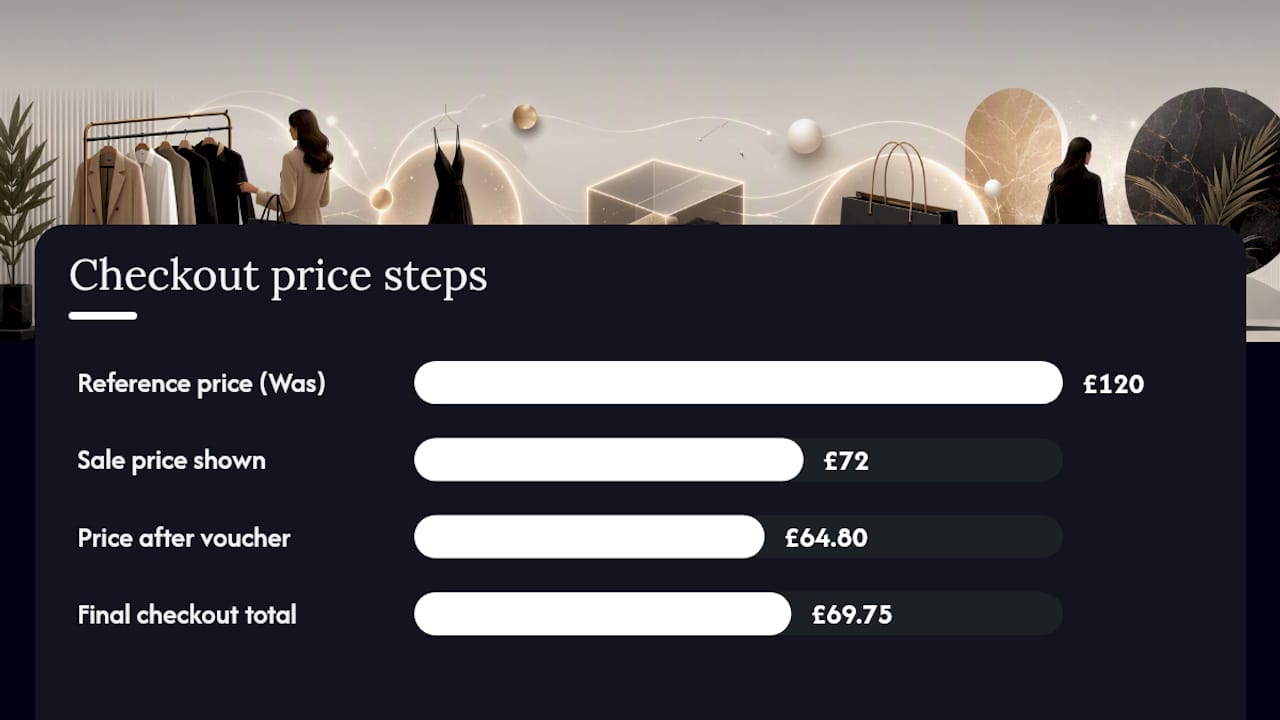
- Reference price (Was): £120
- Sale price shown: £72 (retailer claims 40% off — check: (£48 ÷ £120) × 100 = 40% ✓)
- Voucher code — extra 10% off the sale price: £72 × 10% = £7.20 off → price after code: £64.80
- Delivery charge: £4.95 (mandatory, not free at this order value)
- Final checkout total: £64.80 + £4.95 = £69.75
Now recalculate the true saving against the original £120:
- Absolute saving: £120 − £69.75 = £50.25
- True percentage saving: (£50.25 ÷ £120) × 100 = 41.9%
Without delivery the saving looks slightly better (42.7%). With delivery included it is 41.9%. Neither figure is wrong, but the one that matters is the one that reflects what leaves your bank account. For a fashion sale purchase, always run this final step before deciding whether the deal clears your personal value threshold.
Why the maths matters more than the feeling
Price anchoring is genuinely powerful. Seeing “Was £120” next to “£72” triggers a sense of gain before you have done any arithmetic. That psychological pull is the whole point of a “Was/Now” tag, and it works even on people who know it is happening.
Running the numbers does not kill the pleasure of a good deal. It just confirms whether the deal is real. When the maths checks out — the reference price was genuine, the discount applies to your size, and the basket total including delivery still beats buying elsewhere — you can buy with confidence rather than hope.

From a shopper’s perspective, the most underrated check is the simplest: does the “Was” price appear anywhere other than this retailer’s own sale banner? If a dress is listed at £120 on one site and £65 everywhere else, the £120 was never a realistic price. The Consumer Protection Act 1987 exists precisely because that kind of inflation is not just misleading — it is unlawful. Your statutory rights under the Consumer Rights Act 2015 also apply to sale items: a faulty garment bought in a sale carries the same repair, replacement, or refund entitlement as one bought at full price.
Jvwear publishes clear Was/Now pricing, offers free UK shipping above its threshold, and provides a 30-day hassle-free returns window — policies worth checking against the checklist in this guide before any purchase.
Shop Jvwear with the checklist in hand
Jvwear’s sale collections give you a real place to practise every step in this guide. Pick a piece — say, the Two Piece Midi Dress Set or the Eden V Neck Mini Dress — note the Was/Now prices, apply the formula, run the basket test with any active code, and confirm the total including delivery. Free UK shipping applies above the qualifying order value, and returns are accepted within 30 days, so the financial risk of testing a purchase is low. Browse the current cardigans collection to see transparent pricing on a live range and put the maths to work straight away.
Sources
Official regulator guidance:
- promotional-savings-claims.html
- Gov
- Legislation
- CMA209: Unfair commercial practices & price transparency (document)
- Retail markdowns (Shopify blog)
Practical reading:
This article is general information, not a substitute for advice from a qualified lawyer. Consult a qualified legal professional about your own circumstances before acting on anything here.