Minimalist outfits photograph well because they give the camera a single, legible subject. Without competing patterns, clashing colours, or busy accessories, the lens has one clear focal point: the shape of the clothing, the quality of the fabric, and the person wearing it. The result is images that feel timeless rather than dated, and elegant rather than effortful. The core reasons come down to five things:
- Clear silhouette — a simple shape reads instantly and holds attention
- Controlled colour — neutral tones behave predictably under any light source
- Readable texture — fabric detail becomes visible when there is nothing else to look at
- Less compositional distraction — the eye goes straight to expression and posture
- Fewer post-processing problems — no clashing hues, no logo removal, no pattern correction
Key takeaways
Minimalist outfits photograph well because they reduce visual competition and let the camera focus on what matters: silhouette, texture, and the person wearing the clothes.
| Point | Details |
|---|---|
| Silhouette is the foundation | A clean, unbroken line from shoulder to hem gives every frame its structure. |
| Neutral tones behave predictably | They hold their value across studio and natural light without clipping highlights or shifting colour. |
| Texture replaces pattern | One fabric with visual weight, linen, rib knit, dense cotton, adds interest without clutter. |
| Fit matters more than anything | A precisely fitting garment needs no styling tricks; small tailoring adjustments change how a silhouette reads on camera. |
| Jvwear for shoot-ready pieces | JV London’s cardigans, midi dresses, and coordinated sets are built around the neutral, structured silhouettes that photograph consistently well. |
Table of Contents
- Why do minimalist outfits photograph well? The visual and technical reasons
- Studio versus outdoor: how does the setting change what you wear?
- Practical outfit formulas that consistently photograph well
- How do stylists make minimalist outfits feel interesting on camera?
- Final checklist before the shoot
- The part of minimalism most people get wrong
- Camera-ready minimalist pieces from Jvwear
- Sources
Why do minimalist outfits photograph well? The visual and technical reasons
The camera does not see the way the human eye does. It compresses three-dimensional space into a flat frame, and in doing so, it amplifies anything that fights for attention. A bold graphic print that looks fine in a mirror can read as visual noise in a portrait. A logo across the chest pulls the eye away from the face. Minimalist outfits sidestep all of that.
Minimalist photography is built on clean lines, negative space, and a single focal subject. When clothing follows the same logic, the outfit and the photographic approach reinforce each other. The subject becomes the story.
Silhouette and negative space work together to direct the viewer’s eye. A fitted trouser and a simple top create a vertical line the camera can follow from shoulder to hem. That line is what gives a portrait its sense of structure. Busy clothing breaks that line into fragments.
Neutral tones interact with a camera’s exposure system more gently than saturated colours. Bright reds and yellows can blow out highlights or force the camera to underexpose the subject’s skin. Neutrals, from ivory to warm stone to soft charcoal, sit within a manageable dynamic range and hold their value across studio strobes, overcast daylight, and golden-hour sun. They also layer without visual conflict, which makes them easier to match to common studio and outdoor backgrounds, producing genuinely timeless imagery.
Texture is where minimalism earns its visual interest on camera. When there is no print to look at, the eye moves to how light falls across a fabric’s surface. A matte linen blazer reads differently from a silk blouse: the linen scatters light and creates soft shadow, adding depth; the silk reflects it, which can create unwanted hotspots unless lighting is controlled. Knit weight matters too. A heavy-gauge knit holds its structure in frame; a fine-gauge one can look flat or even transparent under strong light.
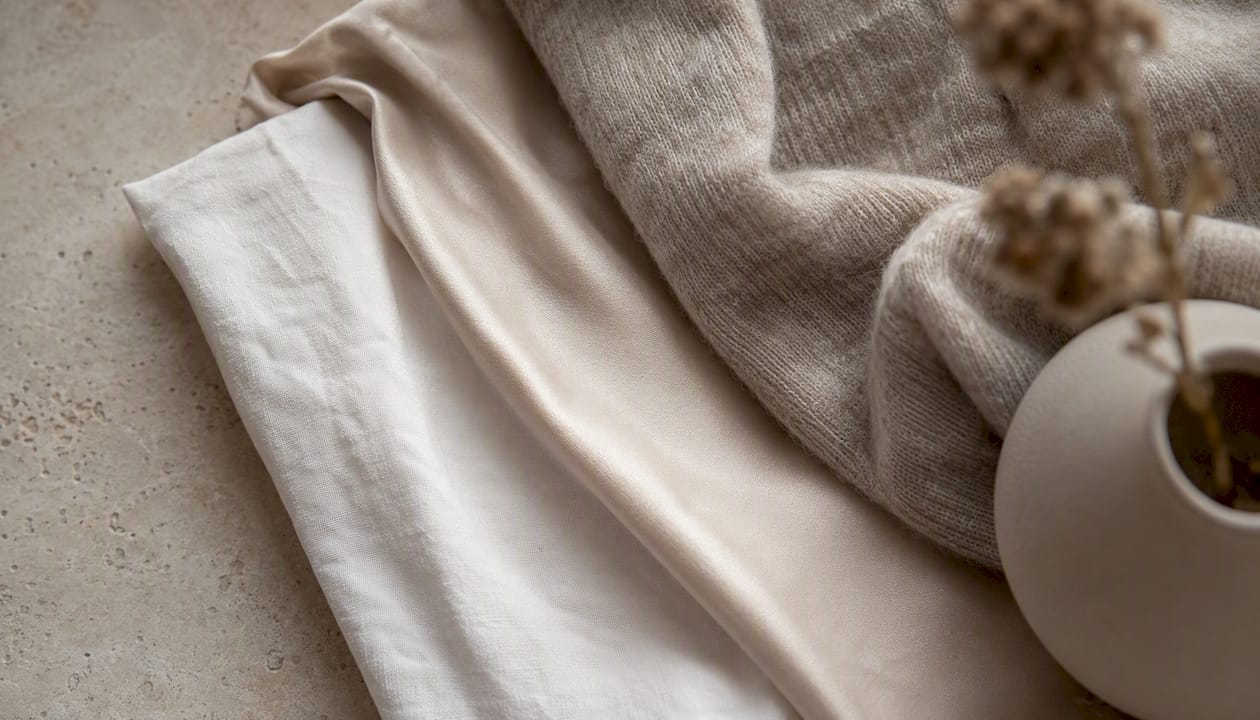
Patterns and logos create a specific problem: they anchor the viewer’s attention in the wrong place. A slogan across the chest competes directly with the subject’s face. A busy floral print fragments the silhouette. Neither is easy to fix in post-processing.
Pro Tip: Before a shoot, run a quick fabric test. Hold the garment under the room’s dominant light source and look for shine, transparency, or colour shift. What you see is roughly what the camera will record.
Studio versus outdoor: how does the setting change what you wear?
The setting changes almost everything about how a minimalist outfit performs on camera.
In a studio, light is controlled. That control is a significant advantage for minimalism because it means you can predict exactly how a fabric will behave. Matte fabrics, dense cottons, wool blends, and structured linens are ideal here: they absorb light evenly and hold their shape without unexpected highlights. Avoid very pale or white garments directly under a hard strobe unless the photographer plans to dial down the power, since pale tones can clip to pure white and lose all detail. A successful minimalist fashion shoot depends on the garment, the light, and the frame working together, and the studio gives you the most control over all three.
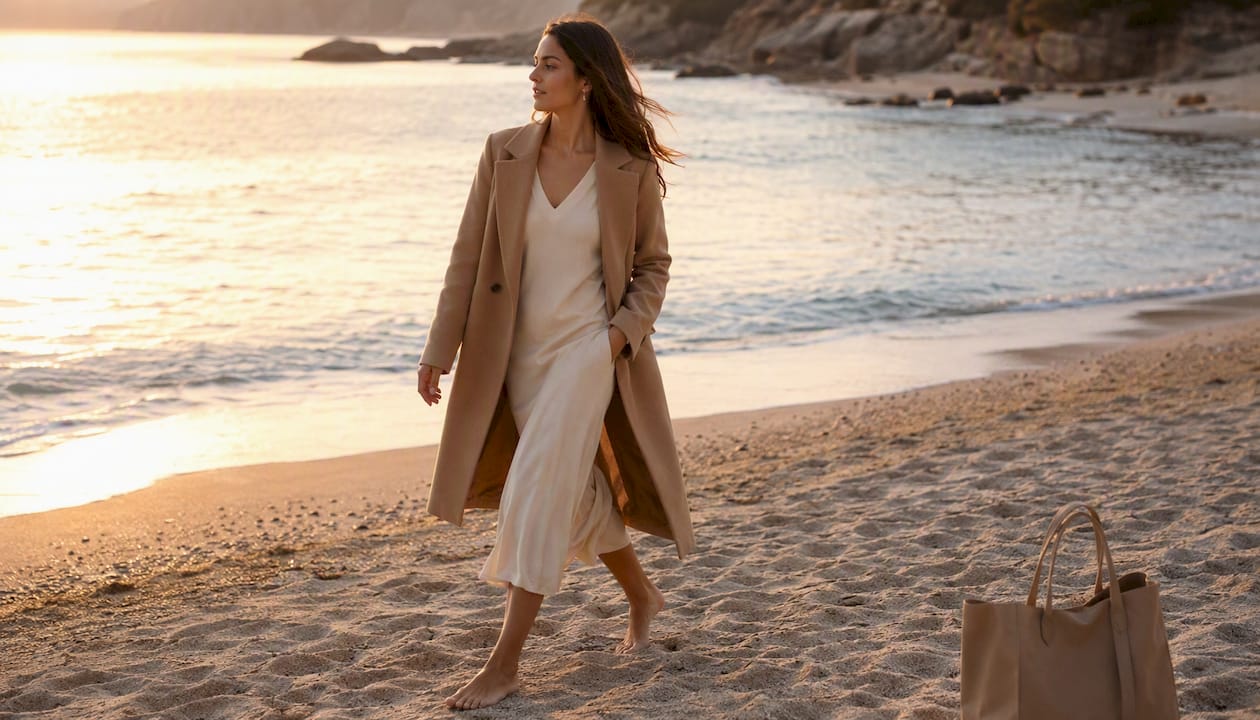
Outdoors, the light changes by the minute. Overcast days are genuinely the most forgiving for minimalist outfits because the diffused light wraps around the subject and reduces harsh shadows. Golden hour works beautifully with warm neutrals, ivory, and camel. Avoid very dark navy or black on bright days: the contrast between a dark garment and a bright sky can push the camera’s exposure into difficult territory.
Background complexity is the outdoor variable most people underestimate. A subject wearing stone-grey against a grey concrete wall will merge into the background. The fix is simple: bring a contrasting layer. A cream coat over a charcoal dress, or a warm tan top against a green park, creates enough separation for the camera to read the subject clearly.
Pre-shoot checklist for setting decisions:
- Confirm the background colour or tone with the photographer before you pack
- Bring one textured layer (a cardigan, a structured jacket) as a swap option
- Pack an alternative collar or neckline to change the frame around the face
- Include a neutral outer layer that works over multiple base outfits
- Bring two shoe options: one flat, one with a heel, to adjust the silhouette
Practical outfit formulas that consistently photograph well
Concrete formulas take the guesswork out of getting dressed for a shoot. These combinations work reliably across studio and outdoor settings.
Monochrome base with a textured accent. A single colour from head to toe creates a strong, unbroken silhouette. Add one textured piece, a ribbed cardigan, a linen blazer, a woven bag, to prevent the look from reading flat. The texture catches light and creates visual interest without introducing a second colour to manage.
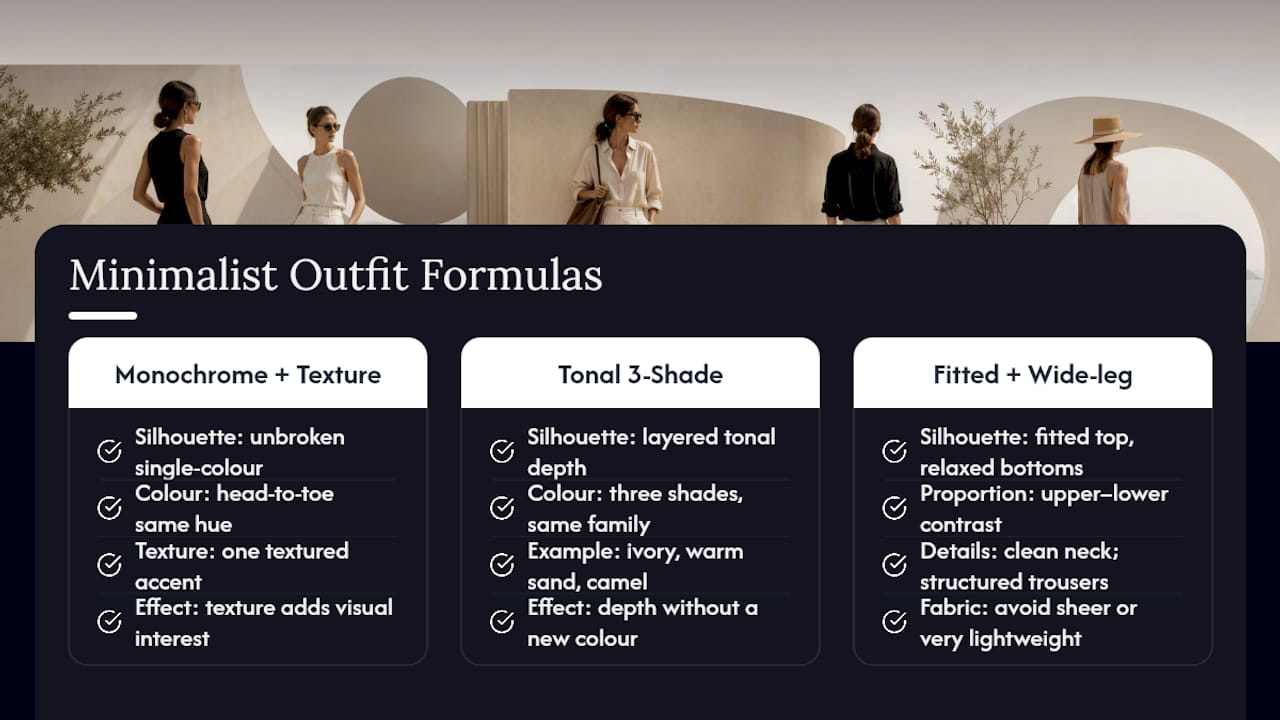
Tonal layering using the three-tone rule. Choose three shades from the same colour family, for example ivory, warm sand, and soft camel, and layer them. The tonal variation creates depth the camera can read, while the shared undertone keeps the image cohesive. This formula works particularly well for everyday minimalist outfit formulas that need to feel polished without looking overdressed.
Fitted top with wide-leg trousers. The contrast between a close-fitting upper half and a relaxed lower half creates a proportional balance that photographs well in both portrait and full-length frames. Choose a top with a clean neckline and trousers with a sharp crease or structured fabric. Avoid very lightweight or transparent fabrics in the trouser unless the shoot is specifically lit for it.
Dress with a long coat for vertical lines. A midi or maxi dress under a long coat creates a continuous vertical line from shoulder to hem. This is one of the most reliable formulas for editorial-style portraits. The coat adds structure; the dress underneath softens it. Fabric weight matters: a coat in a dense wool blend or structured cotton will hold its shape in frame, while a flimsy outer layer can collapse and read as shapeless.
On accessories: one statement object is the ceiling. A single bag, a single ring, a single pair of earrings. Metallics work best when they are understated, a thin gold band rather than a chunky chain, because reflective surfaces near the face can create small hotspots that distract from expression. The same logic applies to shoes: a clean, simple silhouette reads better than an embellished one.
Pro Tip: Avoid transparent or open-weave knits unless the photographer has specifically planned the lighting for them. Under a strong backlight, a loosely woven top can become unexpectedly sheer.
How do stylists make minimalist outfits feel interesting on camera?
The risk with minimalism is that it tips into blandness. Stylists avoid this through three moves: proportion play, deliberate texture contrast, and one considered accessory.
Minimalist fashion relies on timeless staples, careful proportion, and a restrained palette. The key is treating the outfit as a composition rather than a collection of items. A white shirt tucked into wide trousers is not interesting because of the shirt or the trousers individually. It is interesting because of the relationship between them: the volume below, the clean line above, the way the tuck creates a waist.
Fabric quality becomes more visible in minimalist outfits, not less. When there is no print or trim to look at, the camera reads the weight of the cloth, the precision of the seam, and the way the garment falls. Minimalist garments reveal construction because there is nothing else to look at. A well-cut linen shirt and a cheap one look identical on a hanger; on camera, the difference is immediate.
Stylists advise using proportion, texture, and one considered accessory to prevent minimal outfits from looking flat or boring in photographs. The interplay of an oversized piece with a fitted one, or a smooth fabric against a textured one, adds visual interest without clutter.
Pro Tip: Steam every garment before the shoot. Creases read on camera far more strongly than they do in person, and a smooth fabric surface is the foundation of a clean minimalist image.
Final checklist before the shoot
Use this list the morning of the shoot. It takes five minutes and prevents the most common minimalist outfit mistakes.
- Steam all garments the night before; re-check for creases on the day
- Remove all visible logos and brand labels from outer garments
- Pack tonal alternatives — at least one lighter and one darker version of your base colour
- Include a textured layer such as a cardigan, knit, or structured jacket
- Plan footwear carefully — bring two pairs with different heel heights to adjust the silhouette
- Avoid busy patterns including fine stripes, which can create a moiré effect on camera
- Check for transparency by holding garments up to a window before packing
- For group or family shoots, coordinate by tone rather than matching exactly — shared neutrals create cohesion without looking uniform
Camera and lighting reminders for photographers:
- Apply positive exposure compensation (+0.3 to +0.7 stops) for very pale or white garments to prevent them reading as grey
- Watch for highlight clipping on shiny fabrics; reduce light intensity or flag the source rather than correcting in post
- With outdoor shoots in changing light, bracket exposures when the subject is wearing very light or very dark tones
The part of minimalism most people get wrong
There is a version of this advice that leads people to show up in a beige outfit that says nothing. That is not minimalism. That is avoidance.
The real work in minimalist styling is intentionality. Start with fit: a garment that fits precisely is already doing most of the work. Then texture: choose one fabric that has something to say under light, a heavy linen, a dense rib knit, a structured cotton. Then one personal detail that is genuinely yours, a specific shoe silhouette, a single piece of jewellery with meaning, the way you cuff a sleeve.
That last part is what separates a memorable minimalist image from a forgettable one. Cuffing a sleeve changes the proportion of the arm and creates a small, deliberate detail the camera notices. Swapping a pointed-toe flat for a rounded one shifts the whole mood of a trouser look. These are not styling tricks. They are decisions, and decisions are what make a photograph feel like it belongs to a specific person rather than a stock image.
Minimalism gives the camera less to look at when you build your modern urban wardrobe now — Urbalenti™ NYC with carefully chosen staples. That is only an advantage if what remains is worth looking at. Precise fit and small tailoring adjustments are the most cost-effective way to make sure it is. A garment that fits well on camera needs no explanation. You can also explore how minimalist dressing works in everyday style to build a wardrobe that is already shoot-ready before you open the brief.
Camera-ready minimalist pieces from Jvwear
Jvwear’s collection at JV London is built around exactly the kind of pieces this guide recommends: clean silhouettes, neutral tones, and fabrics that hold their shape in frame. The cardigans range covers the textured layer every minimalist shoot needs, from ribbed knits to structured button-fronts that work over a base dress or tucked into wide trousers. For a ready-to-shoot coordinated option, the two-piece midi dress set pairs a clean midi silhouette with a button-front cardigan in tonal shades. The belted midi dress creates the vertical editorial line that photographs well in both studio and outdoor portraits. Free UK shipping and 30-day returns mean you can order two options, keep the one that works best on camera, and return the other. Browse the full collection at Jvwear before your next shoot.
Sources
- Minimalist photography tips - Adobe
- How To Master the Art of Minimalist Fashion | Vogue
- Minimalists on the fashion rules that make or break your style | Who What Wear