Sizing uncertainty is the single largest reducible cause of fashion returns. Coresight Research found that 53% of apparel sellers cite size and fit as the top return reason, with an online apparel return rate of approximately 24.4% in the 12 months to March 2023. The mechanism is straightforward: when a shopper cannot confidently predict how a garment will fit their body, they either guess and return, or bracket (order multiple sizes) and return the rest.
Three fixes move the needle fastest:
- Fix PDP fit data first. Add flat garment measurements, model height and measurements, and fit notes (runs small, relaxed cut) to every high-return SKU. This costs almost nothing and reduces uncertainty immediately.
- Run a targeted sizing-tool pilot. Deploy a size recommender on your worst-performing SKUs, not site-wide. Peer-reviewed evidence puts realistic return reductions in the high single digits, so test before you invest.
- Introduce an exchange-first returns flow. Prompt customers to swap sizes before issuing a refund. This preserves revenue, reduces net return volume, and protects margin.
The near-term payoff is a modest return-rate drop. The bigger gain is customer lifetime value: shoppers who find their size and feel confident tend to buy again.
Key takeaways
Fixing online sizing causes returns to fall, but the biggest commercial gain is CLV: shoppers who find their size reliably spend more over time than the return-rate reduction alone suggests.
| Point | Details |
|---|---|
| Size/fit drives most returns | 53% of apparel sellers cite size/fit as the top return reason; 53–70% of returns are fit-driven. |
| PDP fixes come first | Add flat garment measurements, model data, and fit notes before investing in any sizing tool. |
| Tool effects are modest | Peer-reviewed tests show approximately 3.8% size-related return reductions; CLV uplift of 7.51% next quarter is the stronger commercial case. |
| Exchange-first preserves revenue | Prompting customers to swap sizes before refunding converts returns into retained sales. |
| Measure at SKU level | Track return reason codes and bracket rates by SKU weekly; overall return rate is too blunt a signal. |
This month: Fix five high-return PDPs. Add measurement tags to your returns portal so size/fit codes are captured at SKU level.
This quarter: Pilot a size recommender on 10 SKUs with a control group. Introduce an exchange-first prompt in your returns flow. Review bracket rates monthly.
This year: Scale PDP measurement standards across all categories. Evaluate whether sizing-tool data justifies a broader rollout. Explore body-data opt-ins and industry sizing collaboration where your category warrants it.
Table of Contents
- Why online sizing causes returns: the root causes
- What your product page must show to cut size-induced returns
- What sizing tools actually change, and how to evaluate them
- Return-policy and operational levers that change return behaviour
- How to measure the impact of sizing changes
- A practical pilot plan you can run in 8–12 weeks
- What to prioritise next quarter
- Sources
Why online sizing causes returns: the root causes
Between 53% and 70% of online apparel returns are driven by fit or sizing issues, with appearance mismatch adding roughly 22% and defects about 10%. That concentration matters because it means the problem is largely solvable at the product-data and policy level, not the supply-chain level.
Size labels are a noisy signal
A UK size 12 dress from one brand can measure 4–6 cm wider in the bust than a size 12 from another. A UK survey found that a substantial share of shoppers say their usual size often or always varies between brands, with very few reporting consistent sizing across brands. The label, in other words, tells the shopper almost nothing reliable about whether the garment will fit.
This is the structural problem that underpins why online sizing causes returns at scale. Without a shared standard, every purchase is a gamble.
Missing garment measurements raise uncertainty
Most product pages show a size guide that maps body measurements to size labels. That is useful but incomplete. What shoppers actually need is the garment’s own measurements: the chest width laid flat, the length from shoulder to hem, the waist at the seam. A shopper who knows her bust is 90 cm and the garment chest is 96 cm laid flat can make a confident decision. Without that data, she is guessing.
Fit notes compound the gap. “Relaxed fit” and “oversized” mean different things to different buyers. Without a concrete measurement or a comparison to a standard fit, those descriptors add noise rather than clarity.
Visual and context problems get filed as fit failures
Poor photography is a hidden driver of returns due to sizing. When a dress is shot on a single model with no stated height or measurements, at a flattering angle, with no sense of how the fabric drapes on a real body, shoppers misjudge length, volume, and proportion. They receive the garment and it looks nothing like the image. They file the return as a size issue because the garment does not look right on them, even when the measurements are technically correct.

Category matters here. Dresses, shirts, and outerwear are the categories most frequently cited in size and fit returns, and they are also the categories where visual context is hardest to convey in a single hero shot.
Bracketing and free-returns normalisation
27% of UK shoppers regularly order multiple sizes intending to return the ones that do not fit. Free, frictionless returns made this rational. The shopper is not being unreasonable; she is adapting to a system that cannot give her reliable fit information upfront. Bracketing inflates gross return volumes, distorts return-rate metrics, and adds cost at every stage of the returns process.
Fabric and silhouette effects
A woven cotton dress behaves predictably. A ribbed knit or a jersey wrap does not. Stretch fabrics can fit a range of body sizes, but they also look and feel very different at different points in that range. A shopper who orders a jersey midi in her usual size may find it fits technically but clings in ways she did not expect. She returns it. The product page said nothing about stretch percentage, fabric weight, or how the silhouette behaves on a fuller bust.
What your product page must show to cut size-induced returns
The product detail page (PDP) is where fit confidence is won or lost. Most of the fixes here are content changes, not technology investments.
Prioritised PDP checklist
- Flat garment measurements: chest, waist, hip, length, and sleeve (where relevant) measured on the garment itself, not the body. State the size the measurements apply to.
- Model height and measurements: “Model is 5’8”, wearing a size 10" gives shoppers a reference point that a size chart cannot.
- Fit notes: “Runs small, size up if between sizes” or “true to size, relaxed through the hip.” Keep these specific and honest.
- Multiple body contexts: show the same product on at least two different body shapes or sizes where possible. A dress that looks fitted on a size 8 model may look completely different on a size 14.
- Short fit video: a 15-second clip of the model moving in the garment shows drape, stretch, and length in a way no static image can.
- Review-derived fit signals: surface aggregate data from customer reviews: “82% of reviewers say true to size” or “average reviewer height: 5’5”." This is social proof applied directly to fit confidence.
For practical guidance on building accurate size tables across a distributed product range, the EcomEye size-table guide covers the mechanics in detail.
Garment measurements vs body measurements
| Dimension | Garment measurements | Body measurements |
|---|---|---|
| What it measures | The physical garment laid flat | The customer’s own body |
| Best use on PDP | Lets shoppers compare to garments they already own | Feeds size recommenders and size guides |
| Accuracy risk | Low if measured consistently at the same points | High: self-reported body data is often inaccurate |
| Customer effort | Low: they measure a garment they own | Medium to high: requires tape measure and correct technique |
| When to prioritise | Always, as a baseline | When running a size recommender tool |
Both types of data serve different purposes. Garment measurements are the higher-priority fix because they require no customer action and no technology. Body measurements become valuable when you layer a size recommender on top.
How to surface review fit signals
If your platform aggregates review data, add a fit-vote widget: “Does this run true to size?” with a simple thumbs-up/thumbs-down split. Once you have 30 or more responses, display the aggregate. This is a low-cost, high-credibility signal because it comes from real buyers.
Pro Tip: For photography, shoot dresses and tops at eye level rather than from above. A slightly elevated camera angle makes hems look shorter and waists look narrower than they are in reality. Eye-level shots give shoppers a more accurate sense of proportion, which reduces the “it looked different online” return reason. See Jvwear’s UK shopping guidance for more on how visual context shapes purchase confidence.
What sizing tools actually change, and how to evaluate them
Size recommenders and AR/3D try-on tools are often sold as return-reduction solutions. The evidence is more nuanced than vendor pitches suggest.
What the peer-reviewed evidence says
A controlled A/B test on Zalando’s SizeFlags tool (KDD 2021) found that size advice reduced size-related returns by approximately 3.8% in that test. That is a real, reliable effect, but it is well below the 18–30% average reductions that industry and vendor analyses estimate. The gap between peer-reviewed results and vendor claims is consistent across the literature.
Field evidence from a large fashion platform found that size-finder users were 0.65 percentage points more likely to return items in that sample. The tool encouraged more trial purchases, some of which came back, but the customers who used it spent more over time.
The implication: do not evaluate sizing tools solely on short-term return rates. The strategic value is often a net CLV gain, not an immediate return reduction.
When to prioritise which tool type
Single-brand size engines (trained on your own returns and review data) tend to outperform multi-brand solutions for retailers with a consistent fit philosophy and enough historical data. Multi-brand tools are better for marketplaces or retailers with highly varied supplier bases. Category fit matters too: a size recommender works well for fitted dresses and structured outerwear, where garment dimensions are predictable. It adds less value for stretch knits and relaxed cuts, where the fit range is wide by design.
Research distinguishing non-contextual fit from contextual fit is useful here. Non-contextual fit (does the garment’s chest measurement match the shopper’s bust?) is addressable with descriptive data. Contextual fit (does this relaxed linen dress suit my body shape and personal preference?) is harder to resolve with a tool and may require richer visual content instead.
Pilot checklist before you invest
- Select 10–15 high-return SKUs in one category (dresses or outerwear are good starting points).
- Establish a four-week baseline: return rate by SKU, return reason split (size/fit vs other), and bracket rate.
- Deploy the tool on half the SKUs; leave the other half as control.
- Run for eight weeks minimum to accumulate statistical significance.
- Measure: return rate by SKU, size-related return rate, CLV at 90 days, conversion rate, and bracket rate.
- Before signing a contract, confirm: what data does the vendor access, how is body data stored and consented, what are the integration costs, and what ongoing maintenance does the tool require?
Vendor evaluation checklist
- Data access and privacy: does the tool require body measurements, and how are they stored and consented under UK GDPR?
- Accuracy claims: ask for peer-reviewed evidence or a controlled pilot result, not aggregate platform averages.
- Integration cost: API or widget? What is the implementation timeline and ongoing maintenance burden?
- Category coverage: is the model trained on data relevant to your product types?
- Unintended effects: does the vendor report any increase in purchase frequency or short-term return uptick?
Return-policy and operational levers that change return behaviour
Policy shapes behaviour as much as product data does. The right levers reduce net return volume without alienating your best customers.
Policy levers with pros and cons
- Exchange-first flow: prompt customers to swap sizes before requesting a refund. It preserves revenue, reduces net returns, and keeps the customer relationship intact. Risk: adds friction for customers who genuinely received a defective item.
- Return fees for non-exchange returns: a modest fee (£1.99–£2.99) reduces casual returns and bracketing without eliminating returns entirely. Risk: can deter first-time buyers if not communicated clearly upfront.
- Shorter return windows: reducing from 30 to 14 days for sale items reduces late returns but can reduce conversion on those items.
- Pre-paid returns vs paid returns: pre-paid labels reduce friction and increase customer satisfaction but add cost. Paid returns reduce volume but can damage brand perception if applied broadly.
- Alterations or repair credits: offering a small credit towards alterations (for example, hemming) can convert a return into a kept item. Niche application, but effective for higher-price-point dresses.
For a detailed breakdown of the UK returns process and how to communicate policy changes to customers, Jvwear’s guide to returning clothes online covers the operational and customer-communication side.
Operational changes that reduce return cost
- Capture return reason codes at SKU level. “Size too small” and “size too large” are separate codes. Aggregate these weekly by SKU and size to identify which specific size in a specific product is driving returns.
- Add size-specific return tags. When a size 14 in a particular dress returns at three times the rate of a size 12, that is a product-data problem, not a customer problem. Tag it, investigate the garment measurement, and fix the PDP.
- Inbound sorting for high-return SKUs. Route returns from flagged SKUs to a dedicated QA check. Are the garments measuring consistently? Is there a production variance?
- Refurbishment and resale routing. Returned items in good condition can be resold at a discount rather than written off. This recovers margin and reduces waste. For context on the economics of returned-stock routing, the apparel resale pricing guide from Tekton LA covers the margin mechanics.
Pro Tip: When communicating policy changes (particularly the introduction of return fees), frame the message around what the customer gains: faster exchanges, better sizing data, and a more sustainable service. Customers who bracket habitually are often your highest-volume buyers, so alienating them with a blunt fee announcement can cost more than the returns themselves.
Non-branded example: PDP fixes plus policy change
A mid-size womenswear retailer added flat garment measurements and model data to its 20 highest-return dress SKUs, then introduced an exchange-first prompt in its returns portal. Over one quarter, size-related returns on those SKUs fell, exchange rates rose, and the net refund volume dropped. The PDP fix reduced uncertainty; the policy change captured customers who would otherwise have refunded and left.
How to measure the impact of sizing changes
Measurement is where most sizing initiatives fall apart. Teams implement changes, watch overall return rates, and draw the wrong conclusions because they are looking at the wrong metrics.
KPI reporting template
| KPI | Owner | Reporting cadence |
|---|---|---|
| Return rate by SKU | Merchandising | Weekly |
| Return reason % (size/fit) | CX / Returns ops | Weekly |
| Bracket rate (multiple-size orders) | Analytics | Weekly |
| Cost per return (net) | Finance | Monthly |
| Exchange-to-refund ratio | CX | Monthly |
| CLV at 90 days (tool users vs control) | Analytics | Monthly |
| Resell rate of returned stock | Logistics | Monthly |
Reporting cadence and ownership
- Weekly alerts: flag any SKU where the size/fit return rate exceeds a defined threshold (for example, 30% of returns coded as size/fit). Assign to merchandising for PDP review within five working days.
- Monthly pilot review: compare tool-exposed SKUs against control SKUs on return rate, CLV, and conversion. Assess whether the pilot is on track for statistical significance.
- Quarterly strategy review: review category-level return rates, cost per return, and CLV trends. Decide which sizing levers to scale, which to retire, and where to invest next.
Instrumenting experiments correctly
Run A/B tests at the SKU level, not the customer level, to avoid contamination. Assign SKUs randomly to treatment and control groups within the same category. Use your analytics platform (Google Analytics 4, or a dedicated experimentation tool) to track the split and avoid peeking at results before the test period ends.
A practical pilot plan you can run in 8–12 weeks
This plan maps directly to a small team at a fashion e-commerce retailer. It is designed to be replicable without a large technology budget.
Step-by-step pilot
- Identify 10 high-return SKUs. Use your returns data to find the dresses, tops, or outerwear with the highest size/fit return rate. Dresses and shirts are the best starting categories, as they are consistently the highest-return categories in apparel.
- Baseline metrics. Record return rate by SKU, return reason split, bracket rate, and CLV for the four weeks before any changes.
- Implement PDP fixes on all 10 SKUs. Add flat garment measurements, model height and measurements, fit notes, and at least one additional body-context image. For reference on what a well-structured product page looks like, the Jvwear two-piece midi dress set and the casual summer mini dress illustrate how measurement and model data can be presented on a real product page.
- Deploy a size recommender on five of the 10 SKUs. Leave the other five as PDP-fix-only controls.
- Introduce an exchange-first prompt in the returns portal for all 10 SKUs.
- Run for eight weeks. Measure weekly: return rate by SKU, size/fit return reason %, bracket rate, exchange-to-refund ratio, and CLV at 30 days.
- Review and decide. At week eight, compare tool-exposed SKUs against PDP-fix-only SKUs. If the tool adds measurable return reduction or CLV uplift beyond the PDP fix alone, expand it. If not, the PDP fix is your primary lever.
Realistic expected outcomes
PDP fixes alone typically produce a meaningful reduction in size/fit returns on the treated SKUs, because they address the information gap directly. The exchange-first prompt should convert a portion of refund requests into exchanges, recovering revenue that would otherwise be lost.
To calculate ROI: multiply the reduction in returned units by your average cost per return (processing, logistics, and write-down). Add the revenue retained through exchanges. Compare against the cost of PDP content production and any tool licensing fees.
Resource and governance checklist
- Product/merchandising: owns PDP content updates and measurement accuracy.
- CX/returns ops: owns exchange-first flow implementation and return reason code capture.
- Analytics: owns experiment design, KPI tracking, and pilot review.
- Logistics: owns inbound sorting and resell routing for returned stock.
- Finance: owns cost-per-return calculation and ROI sign-off.
Pro Tip: Keep the first pilot internal. Resist the temptation to sign a long-term sizing-tool contract before you have eight weeks of your own data. Vendor demos use their best-case results; your category, your customer base, and your PDP quality will produce different numbers. Run the pilot, read the data, then negotiate.
What to prioritise next quarter
The evidence points to a clear execution order, and most teams get it backwards.
The instinct is to reach for technology first: a size recommender, a 3D try-on tool, an AI-powered fit engine. These are appealing because they feel like solutions. PDP content fixes, by contrast, cost almost nothing and address the same information gap directly. Start with the content.
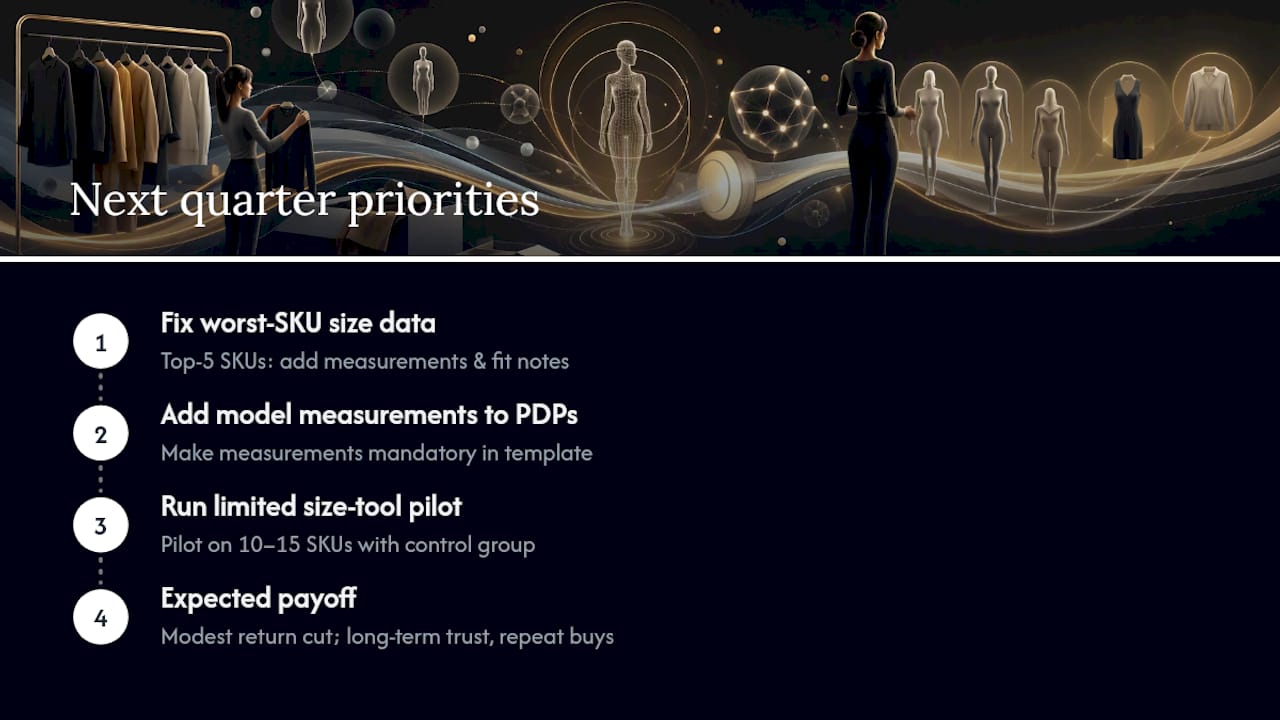
Priority one: fix size data on your worst SKUs. Pull your top five highest-return dresses or tops. Add flat garment measurements, model data, and fit notes this week. This is a one-person task that can be completed in a day per SKU. The return-rate signal on those SKUs should be visible within four to six weeks.
Priority two: add model and measurement content to PDPs systematically. Once you have validated the approach on five SKUs, build it into your standard PDP template. Every new product should launch with garment measurements and model context as a baseline requirement, not an optional extra. This is a process change, not a technology investment.
Priority three: run a limited size-tool pilot. Once your PDP data is clean and consistent, a size recommender has better inputs to work with and will produce more reliable recommendations. A pilot on 10–15 SKUs with a proper control group will tell you whether the tool adds value beyond the content fix alone.
The near-term payoff from this sequence is a modest return-rate reduction on treated SKUs. The longer-term gain is a customer base that trusts your sizing, buys with confidence, and comes back.
Sources
- Average Apparel Return Rate: Benchmarks for Operators | Eightx
- Ecommerce Return Statistics 2026: Rates, Costs, Causes
- Only 1% of online shoppers say clothing sizes are consistent between brands, new survey finds | Retail Times