A work capsule wardrobe is a small, deliberate set of office-appropriate clothes designed so nearly every piece mixes with every other piece, cutting your morning decisions down to a formula rather than a debate. Most professional women land on either a 12-piece lean capsule for hybrid or remote roles, or an 18-piece capsule for full-time office life, and the mathematics behind an 18-piece set commonly produces 40+ outfit combinations from a genuinely small footprint.
If you want to start today rather than plan for a month, here’s the shortest version. Buy or keep these eight pieces first, then build outward:
- A well-fitted blazer in navy or black
- Tailored trousers in a neutral that matches the blazer
- A crisp white or ivory shirt
- One versatile midi or wrap dress
- A fine-knit jumper or cardigan
- A trench coat or structured outer layer
- One pair of comfortable, polished heels or loafers
- A structured bag that fits a laptop or A4 documents
That eight-piece starter set alone gives you roughly a dozen wearable outfits before you’ve bought a single extra item, which is the entire point of building a work capsule wardrobe rather than just a smaller closet.
Key Takeaways
An effective work capsule wardrobe combines 12 to 20 carefully chosen pieces using neutral palettes and a 3-4-3-2 ratio to generate 30 or more outfit combinations.
| Point | Details |
|---|---|
| Audit before buying | Apply the three-match rule: if a piece can’t pair with three items you own, skip it. |
| Choose your palette early | Stick to two or three neutrals plus one accent colour to prevent orphan pieces. |
| Invest in the blazer and trousers | Fit and fabric quality on these two items drive polish more than any other purchase. |
| Test combinations for two weeks | Wear only capsule pieces and record what actually gets worn before buying more. |
| Shop category-first | Use JV London’s cardigans and versatile dresses to fill layering and one-and-done gaps quickly. |
Table of Contents
- What belongs in an office capsule wardrobe checklist?
- How many pieces should a work capsule have?
- How do you build a work capsule wardrobe step by step?
- What are reliable work outfit formulas?
- Which fabrics and fits are worth paying more for?
- Can one capsule really work across all four seasons?
- Why do some capsule wardrobes fail?
- Three sample work capsules you can copy today
- Shopping the capsule: where JV London fits each role
- Ready to build your capsule? Start with the pieces that do the most work
- Sources
What belongs in an office capsule wardrobe checklist?
Every genuinely useful capsule is built from the same core categories, but the exact mix depends on how formal your office is. The blazer is the anchor piece: it upgrades a dress, sharpens trousers, and works over a simple top on days you can’t be bothered to think. Tailored trousers in a neutral shade (black, navy, charcoal, or camel) pair with almost everything else in the set, and a stylist consensus around fit and fabric quality driving polish more than logos or trends means this is where spending slightly more pays off fastest.
Beyond those two anchors, a solid office capsule wardrobe checklist includes:
- A crisp white shirt (the reset button of any outfit)
- One or two versatile dresses (midi length reads as safely professional across most dress codes)
- A fine-knit jumper or cardigan for layering under blazers or alone on warmer days
- A trench coat or tailored wool coat for outerwear
- Two to three pairs of shoes covering flat, block heel, and a slightly dressier option
- A structured tote or work bag
- A slim belt that works across trousers and dresses
- Minimal jewellery: one pair of studs, one simple necklace or chain, one watch or bangle can be a key part of a compact set, as explained in this practical guide to selecting a small, durable set of jewellery for everyday professional wear.
Business formal offices lean harder on suiting and shirts; business casual settings can substitute dark-wash jeans for one pair of trousers, and an 18-piece business casual capsule commonly builds in exactly that flexibility while still producing 30+ outfits. Creative offices give you more room for texture, colour, and statement accessories, but the underlying logic doesn’t change: every piece still needs to earn its place by combining with several others.
Pro Tip: Buy in this order: blazer, trousers, shirt, one dress, shoes. Those five items alone unlock more outfit combinations than any single “statement” piece ever will, however good it looks on the hanger.
How many pieces should a work capsule have?
There’s no single right number, but three counts show up repeatedly across capsule guides for good reason: 12, 15/14, and 18–20. Each suits a different working pattern.
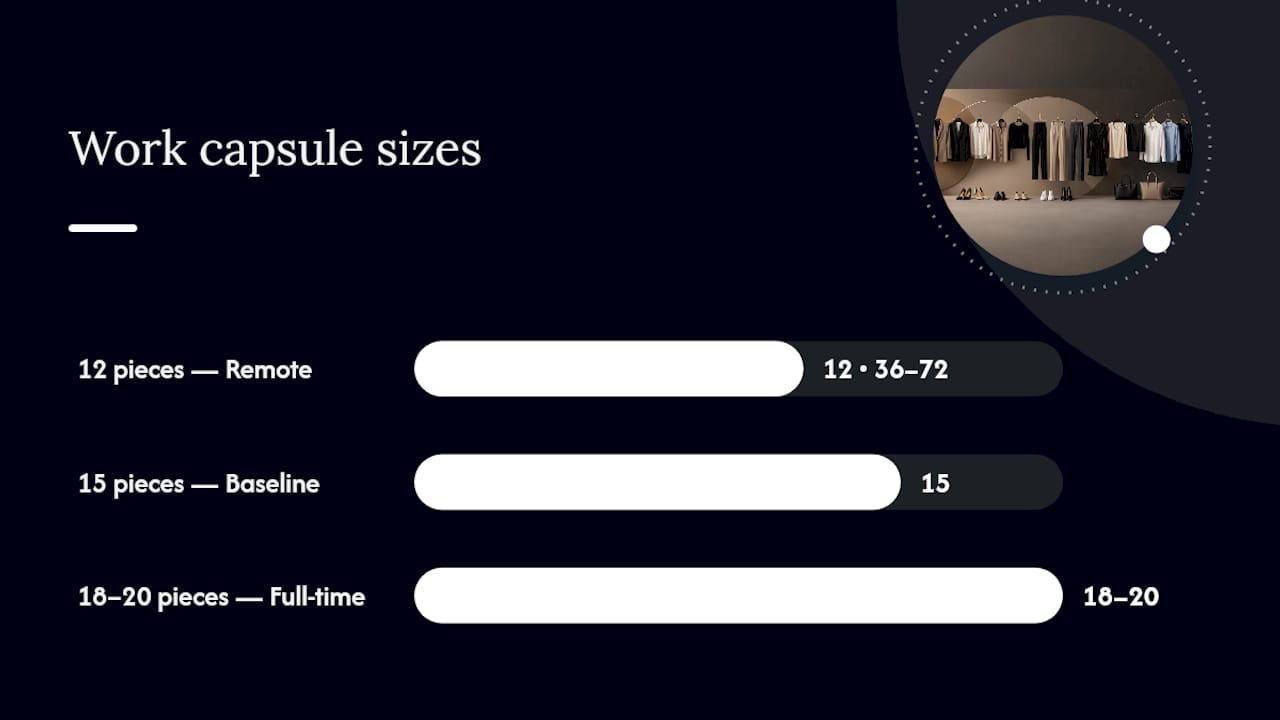
A 12-piece capsule suits remote or hybrid workers who need office-ready outfits only two or three days a week. A 15-piece template is a widely cited baseline that covers most office needs without overbuilding, including tops, bottoms, layers, shoes, and one structured bag. An 18-to-20-piece capsule suits full-time office roles, particularly where client meetings, seasonal variation, and occasional dressier events all need covering. A 20-piece workwear capsule is often built specifically to support four-season wear and to double as a travel wardrobe.
The real trick isn’t the total count. It’s the ratio between categories, and the most reliable formula going is the 3-4-3-2 approach: three bottoms, four tops, three layers (blazers, cardigans, coats), and two pairs of shoes. That ratio is engineered to maximise combinations, and stylists using it report 36 to 72 unique outfit combinations depending on how you layer, from a genuinely compact 12-item set.
| Framework | Piece count | Best suited to |
|---|---|---|
| Lean capsule | 12 pieces | Remote or hybrid, 1 to 2 office days weekly |
| Balanced baseline | 14 to 15 pieces | Most business casual office roles |
| Full-time capsule | 18 pieces | Daily office attendance, client-facing work |
| Four-season capsule | 20+ pieces | Roles needing travel-ready, all-season coverage |
Here’s the maths behind why a small set punches above its weight: with three bottoms and four tops alone, you already have 12 base combinations before adding a single layer or shoe. Add three layering pieces and two shoe options, and you’re multiplying, not adding. That’s how 12 items become 40, and it’s the reason a genuinely well-planned capsule beats a much larger, uncoordinated wardrobe every time.
- Choose 12 pieces if your office attendance is under three days a week
- Choose 15 pieces if you want one reliable baseline with room to add
- Choose 18 to 20 pieces if you’re in the office daily or travel for work regularly
How do you build a work capsule wardrobe step by step?
Building a capsule properly takes an afternoon, not a weekend, if you follow a sequence rather than starting with a shopping trip.
- Audit what you already own. Pull every work-appropriate item out and apply the three-match rule: if a piece can’t pair with at least three other things you own, it’s an orphan and needs to go or be reconsidered. Wear only capsule candidates for two weeks and note what you reach for and what you avoid.
- Define your palette and tag each piece. Pick two or three neutrals (navy, black, grey, or camel) plus one accent colour, since editorial capsule guides consistently recommend this exact ratio to stop colour clashes from creating dead stock. Tag every surviving item by dress code: formal, casual-Friday, or client-facing.
- Fill gaps strategically. List what’s missing after the audit, rank by how many outfits each gap unlocks, and buy the highest-impact item first, usually the blazer or the trousers. Take proper measurements before buying anything tailored: shoulder seam placement, waist-to-hip ratio, trouser break, and sleeve length are the four checks that separate a “fine” fit from one that reads as genuinely polished.
- Run a two-week wearing trial. Wear only capsule pieces, note which combinations feel effortless and which don’t, then make one or two targeted swaps. A capsule is a living system, not a finished purchase, and small iterative tweaks matter more than getting it perfect on day one.
Pro Tip: Book a tailoring appointment for your blazer and trousers before you buy anything else new. A £15 alteration on an off-the-rack blazer usually does more for how “put together” you look than an entirely new outfit.
What are reliable work outfit formulas?
Formulas remove the daily decision entirely, because you’re choosing from a template rather than starting from nothing. Five templates cover almost every office scenario:
- Power: blazer + tailored trousers + fitted top + structured bag, for presentations or client days
- Soft: knit dress + cardigan + flat shoes, for quieter admin-heavy days
- Hybrid: midi dress + blazer + heeled loafer, when a video call and an in-person meeting both land on the same day
- One-and-done: a single well-cut dress with a belt and one accessory, when you genuinely don’t want to think
- Client-ready: the sharpest trousers, the crispest shirt, the best shoes, reserved for days that matter
From a hypothetical 18-piece capsule, here are ten permutations to show how far the formulas actually stretch:
- Navy blazer, white shirt, black trousers, block heels
- Camel cardigan, white shirt, navy trousers, loafers
- Midi wrap dress, navy blazer, ankle boots
- Black trousers, silk cami, cream cardigan, flats
- Wrap dress alone, belted, with a statement necklace
- White shirt tucked into midi skirt, blazer over the top
- Knit jumper, tailored trousers, trench coat, heels
- Midi dress, cardigan swapped for blazer, different shoes for a client meeting
- Trousers and shirt from day one, swap blazer for cardigan for a softer Friday look
- Any dress, worn alone in summer, layered under the trench in winter
Notice how few actual garments generate that list. Pro Tip: Swap only the outer layer or the shoes to shift an outfit’s whole mood. A trench over a soft knit reads corporate; the same knit with no jacket reads relaxed. That’s a free wardrobe change, no purchase required.
Which fabrics and fits are worth paying more for?
Spend where fit is unforgiving and cut corners where it isn’t. The blazer, the coat, and tailored trousers are the three items where quality shows immediately, because tailoring and fabric quality, not logos, are what read as polished in a professional context, according to editorial stylists. Basic tops, plain tees, and simple camisoles tolerate a much lower budget because fit tolerance is wider and the fabric does less structural work.
On fabric specifically:
- Wool blends hold their shape through a full day of sitting and standing, making them the standard for tailored trousers and blazers
- Merino knitwear resists odour, packs without creasing, and works across three seasons
- Silk or silk-blend blouses elevate an outfit instantly but usually need hand-washing or dry cleaning
- Cotton poplin shirts are crisp, breathable, and machine-washable, making them the workhorse choice over silk for daily wear
- Technical or stretch-wool blend trousers travel well and resist creasing, useful if your role involves commuting or travel
When trying anything on, check four points every time: shoulder seams should sit exactly at the edge of your shoulder, never drooping past it; waistbands should sit comfortably without gaping at the back; trouser hems should break just above the shoe; sleeve cuffs should end at the wrist bone, not halfway up the forearm.
- Check the shoulder seam first, since this is the hardest and most expensive fit issue to alter later
- Check waist-to-hip interplay next, sitting and standing to test for gaping
- Check trouser length against your usual work shoes, not bare feet
- Check sleeve length last, since cuffs are the easiest and cheapest alteration
Pro Tip: A tailor can take in a waist or shorten a sleeve for a small fee, but they can’t fix a shoulder seam that’s fundamentally the wrong size. Try the item on with that in mind before you buy, not after.
Can one capsule really work across all four seasons?
Yes, if you build it as a spine with rotating modules rather than a fixed, finished set. The spine is your core 12 to 15 pieces, the ones that work in every season with the right layering: trousers, the white shirt, one or two dresses, a blazer, and your shoe rotation. Around that spine, you swap four to six seasonal pieces rather than rebuilding the entire wardrobe twice a year.
- Swap a light unlined blazer for a wool coat as temperatures drop
- Swap cotton poplin trousers for a heavier wool blend in winter
- Add a lightweight cardigan for spring transitional weeks, remove it for peak summer
- Keep one pair of closed shoes and one pair of open sandals or flats year round, adjusting the ratio seasonally
This same spine-plus-module structure is what makes a capsule genuinely travel-friendly. Because everything already coordinates, packing for a work trip means grabbing the spine pieces plus whichever two or three seasonal items suit the destination, rather than assembling a separate travel wardrobe from scratch.
Pro Tip: Store off-season pieces somewhere separate from your daily rotation, even if it’s just a different shelf. Seeing fewer items each morning is half of what makes a capsule feel effortless rather than cluttered.
Why do some capsule wardrobes fail?
Most capsule failures trace back to one of four specific problems, and each has a fast fix.
- Orphan pieces: an item that doesn’t pair with at least three others. Fix: return it if possible, or donate it and stop buying anything that can’t pass the three-match test in future.
- Wrong palette: too many competing colours mean nothing coordinates cleanly. Fix: audit down to two neutrals plus one accent, and be ruthless about anything outside that palette.
- Poor fit: pieces that technically match the palette but don’t sit right make the whole capsule look unpolished. Fix: one tailoring pass on the blazer and trousers usually resolves this in a single afternoon.
- Seasonal overload: trying to keep summer and winter pieces all in rotation at once dilutes the whole system. Fix: pack away out-of-season modules and keep only the spine plus current-season swaps visible.
If a capsule still isn’t working after fixing all four, run this three-step rescue plan: audit again properly, replace the single worst-performing item rather than several at once, then trial the adjusted set for one full week before judging it. If it still feels wrong after that, the problem may not be the wardrobe at all, it may be a genuine mismatch between your capsule’s dress-code assumptions and your actual office culture. A capsule built for business casual will always feel off in a strictly formal office, and no amount of tweaking fixes that gap; the palette and pieces need rebuilding around the real dress code, not the one you wish you had.
Three sample work capsules you can copy today
Three ready-made templates cover the three most common working patterns: hybrid, full-time office, and a minimalist compact set for anyone who wants the absolute minimum.
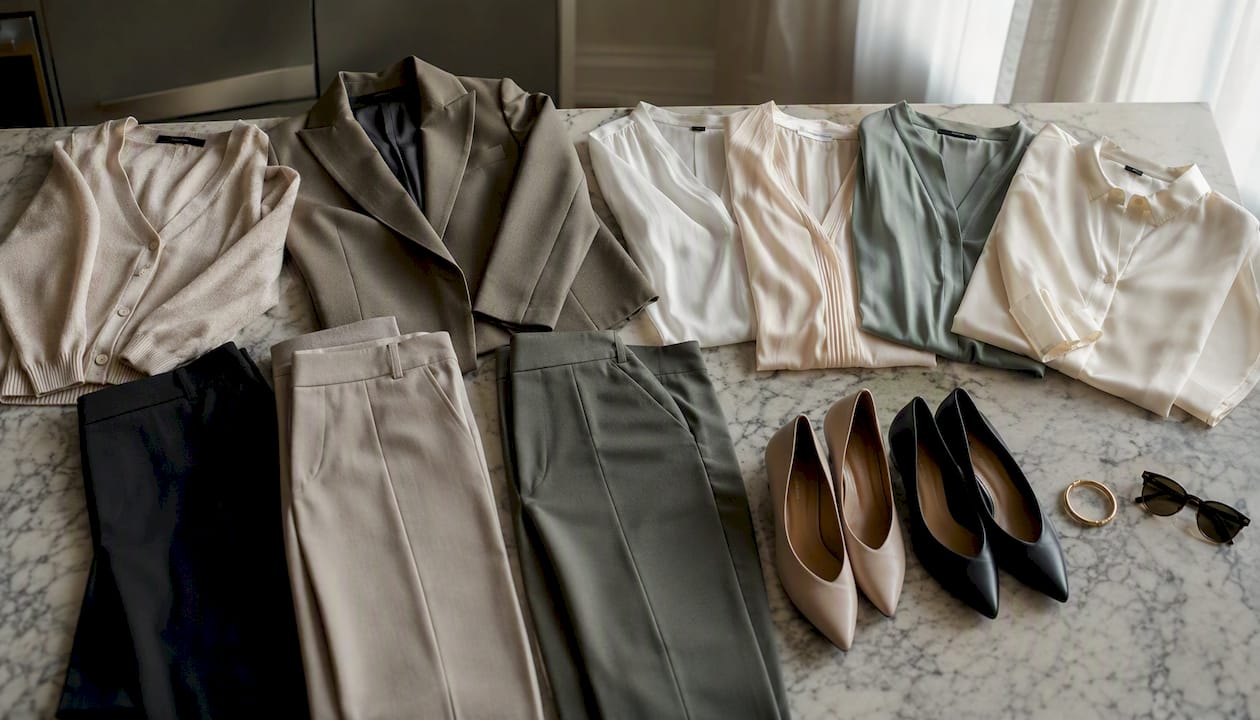
The 12-piece hybrid capsule suits one to three office days a week: one blazer, two pairs of trousers, one midi dress, three tops, one cardigan, one coat, two pairs of shoes, one bag. From this, expect roughly six to eight easy combinations without repeating a full outfit twice in the same fortnight: blazer with either trouser pair, the dress alone or under the coat, tops mixed across both trousers, and the cardigan swapped in for a softer Friday look.
The 18-piece full-time capsule follows the structure behind the 40+ outfit combinations commonly cited for this size: five tops, four bottoms, three outerwear pieces, four footwear options, two accessories. This gives daily variety across a full working month without repetition feeling obvious to colleagues.
The 14-piece compact capsule sits between the two, borrowing the balanced-baseline logic of a 15-piece office template: one blazer, two trousers, one skirt, four tops, two dresses, one cardigan, one coat, two shoes.
| Capsule | Tops | Bottoms | Layers | Shoes | Accessories |
|---|---|---|---|---|---|
| 12-piece hybrid | 3 | 2 | 2 | 2 | 1 |
| 14-piece compact | 4 | 3 | 2 | 2 | 1 |
| 18-piece full-time | 5 | 4 | 3 | 4 | 2 |
- Each capsule assumes you already own basics like tights, camisoles, and everyday jewellery
- Add one accent-colour item to any of the three templates to personalise it without breaking the palette rule
- Start with the 14-piece version if you’re unsure which size suits your role; it’s easiest to scale up or down from there
Shopping the capsule: where JV London fits each role
Mapping capsule roles to actual product categories is where most guides go vague. Here’s the specific version. A cardigan covers the “layers” role in every template above, working over a shirt for structure or over a dress for softness. A two-piece midi dress set does double duty as a one-and-done outfit and as two separate capsule pieces, effectively counting twice against your total piece count.
For the client-ready formula, a belted midi dress with structured sleeves reads polished without needing a blazer over the top, useful on warmer days when layering feels like too much. A structured top-handle bag fulfils the tote role across every capsule size, and for commuting days a quilted crossbody covers the compact-bag gap that most capsule lists mention but rarely solve.
Sample capsule using JV London categories only: one cardigan, one belted midi dress, one two-piece set, one structured bag, one crossbody, plus your own tailored trousers and blazer from elsewhere. That’s six pieces solving four of the five outfit formulas above.
Pro Tip: If you’re shopping a capsule from scratch, buy the layering piece and the one-and-done dress first. Together they cover the two formulas you’ll reach for most on an average week, before you’ve spent anything on shoes or accessories. Free UK shipping and a 30-day returns window make it low-risk to try a fit before committing the rest of your budget.
One habit that actually keeps a capsule working
Building a capsule is the easy part. Keeping it working six months later is where most people quietly give up and drift back into a cluttered wardrobe. The single habit that seems to separate a capsule that lasts from one that slowly falls apart is a monthly “wear and record” check: five minutes at the end of each month, noting which combinations you actually wore and which pieces sat untouched.
That habit does something a one-off audit can’t. It catches drift early, before a single unworn cardigan becomes three, and before “I’ll wear it eventually” becomes six months of dead stock taking up hanger space. It also tells you, with actual evidence rather than a hunch, which single item is worth replacing next. If a piece hasn’t been worn in two monthly checks running, it’s an orphan regardless of how good it looked in the shop, and it should go before the next seasonal swap.
Book one tailoring appointment per quarter as well, even if nothing feels urgent. Bodies shift slightly, fabrics relax, and a blazer that fitted perfectly in January can sit a little differently by autumn. Treat that appointment as part of maintaining the capsule, not as an emergency fix.
Ready to build your capsule? Start with the pieces that do the most work
A work capsule wardrobe only pays off once you own the pieces that unlock the most outfit combinations, and that’s exactly where JV London’s cardigan collection and dress edit earn their keep. Rather than hunting across a dozen sites for one blazer, one dress, and one bag that actually coordinate, JV London groups modern, versatile pieces built to layer and mix, so a single order can fill two or three capsule gaps at once.
Every order ships free across the UK, and you’ve got a full 30 days to return anything that doesn’t earn its place, which matters more with capsule building than with almost any other kind of shopping since fit and versatility only reveal themselves once you’ve actually worn a piece alongside what you already own. Start with a belted midi dress for your one-and-done formula, add a structured bag for the accessories slot, and see how quickly your outfit count climbs from there. Browse the cardigan collection now and fill your layering gap first.
Sources
- Work Capsule Wardrobe: 18 Pieces, 40+ Outfits
- Business Casual Capsule Wardrobe for Women: 18 Pieces, 30+ Outfits (Complete Guide)
- Workwear Capsule Wardrobe: 20 Pieces for the Office
- How To Build A Capsule Wardrobe That Stands The Test …