Curated fashion means deliberately selecting and organising clothing so that every piece earns its place in a coherent, purposeful collection. It is the opposite of accumulation. Where a full wardrobe can still leave you with nothing to wear, a curated one gives you fewer items that work harder. Research on wardrobe curation and cost-per-wear confirms that high-quality, considered pieces cost less per use over time than cheap, disposable alternatives. Bain & Company’s luxury market research identifies consistent aesthetic judgement as a driver of consumer trust, and JV London applies exactly this principle as a curated women’s fashion retailer in the UK.
Three reasons to care about curation right now:
- Reduced decision fatigue. Fewer, more relevant options lower the mental load of getting dressed each morning.
- Better cost-per-wear. A £120 dress worn 40 times costs £3 per wear. A £30 impulse buy worn twice costs £15.
- Clearer personal style. When every item belongs, your wardrobe starts to say something coherent about who you are.
Table of Contents
- What does curated fashion actually include?
- What are the main types of fashion curation?
- How do you curate your own wardrobe?
- What skills do professional stylists and curators use?
- How do brands use curation to shape the shopping experience?
- Common myths about curated fashion, and what’s actually true
- How JV London puts curation into practice
- Key takeaways
- Why curation matters more now than it ever has
- Useful sources and further reading
What does curated fashion actually include?
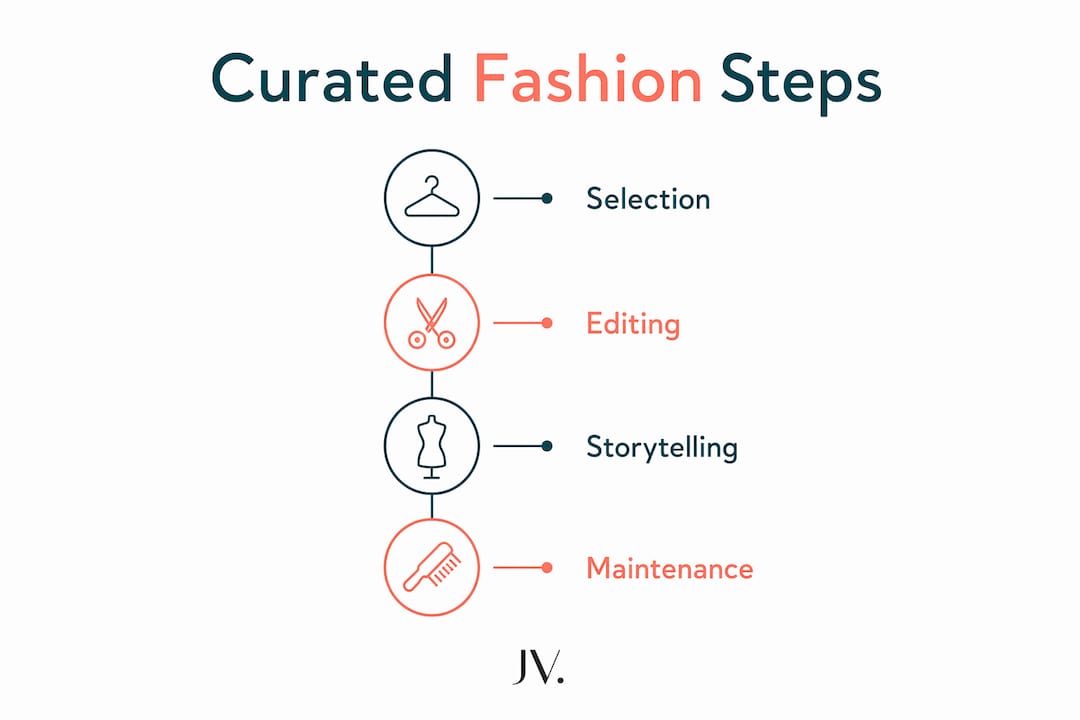
Curation in fashion has four practical components: selection, editing, storytelling, and maintenance. Selection is the gatekeeping stage, choosing what comes in. Editing is the harder discipline, deciding what leaves. Storytelling is how pieces are presented so they feel connected rather than random. Maintenance keeps the collection honest over time, preventing drift back into clutter.
The term overlaps with several related concepts, but the differences matter:
| Concept | Intent | Scale | Longevity |
|---|---|---|---|
| Curated wardrobe | Edited selection guided by personal taste and use | Flexible, grows intentionally | Long-term |
| Capsule wardrobe | Strict minimal set of interchangeable basics | Fixed, usually 10 pieces | Seasonal or permanent |
| Personal styling | A professional service that selects for a client | One-off or ongoing sessions | Depends on the brief |
| Fast fashion | Volume and trend churn | Unlimited | Short-term by design |
A capsule wardrobe is a subset of curation: it applies the same editing principle but with a hard numerical limit. Personal styling is a service that may or may not result in a curated wardrobe, depending on the stylist’s brief. Fast fashion is the structural opposite: it prioritises volume and novelty over coherence. Editorial gatekeeping is what separates genuinely curated shops from unfiltered marketplaces, and the same logic applies to a personal wardrobe.
What are the main types of fashion curation?
Curation shows up in several distinct contexts, each with its own logic.
Personal wardrobe curation is the most intimate form. You audit your existing clothes, define a colour palette and purpose, and edit ruthlessly until what remains works together. A London professional might curate around a neutral base of navy, stone, and white, adding a small selection of seasonal accent pieces annually.
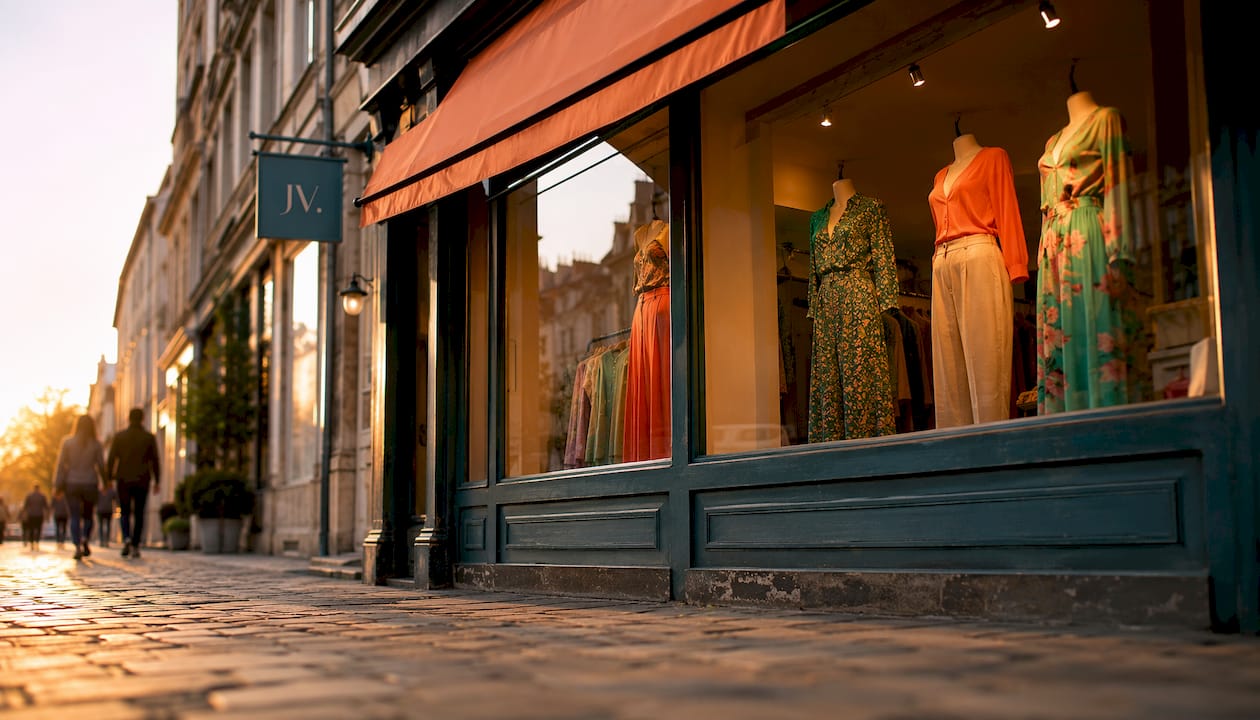
Boutique and store edits are a retailer’s version of the same discipline. A small independent shop on Marylebone High Street, for instance, stocks perhaps 60 styles rather than 600, each chosen to reflect a consistent point of view. The edit does the thinking for the customer.
E-commerce curated marketplaces apply editorial standards to online catalogues. Rather than listing every available product, they vet for quality, fit, and aesthetic coherence before anything goes live. Curated e-commerce is increasingly positioned as an editorial experience rather than a transactional feed, connecting customers with designers and narratives rather than just SKUs.
Editorial curation is what fashion magazines and digital publications do when they assemble a themed shoot or a “10 pieces for autumn” feature. The Victoria and Albert Museum’s fashion exhibitions are the most formal expression of this, where curators select garments to tell a cultural or historical story with scholarly rigour.
Algorithmic curation uses data signals, purchase history, browsing behaviour, and stated preferences to surface relevant pieces. It scales well but tends to reinforce existing taste rather than challenge it. The most effective hybrid models use algorithms to narrow the field, then apply human judgement to the final edit. Authentic curation requires human judgement at the stages of vendor selection, narrative framing, and visual merchandising. Algorithms support that process; they do not replace it.
How do you curate your own wardrobe?
The process takes one focused session to start and a light maintenance habit to sustain. Here is a practical sequence:
- Audit everything. Pull every item out. Assess each one against five criteria: condition, fit, frequency of wear, emotional value, and versatility. If it fails two or more, it leaves.
- Define your purpose and palette. What do you actually do in a week? Work, social, active, casual? Choose two or three neutral anchor colours and one or two accent tones that work across all contexts.
- Edit ruthlessly. Keep only what passes the audit. Donate, sell, or recycle the rest. This step is where most people stall, so set a timer and commit.
- Prioritise tailoring and fit. A well-fitted mid-range piece outperforms an ill-fitting expensive one every time. Budget for basic alterations.
- Fill gaps with versatile pieces. Identify genuine gaps, not wants. A dress that works for both a meeting and a dinner out earns its place; a trend piece that works for one occasion probably does not.
- Set a maintenance routine. Review twice a year, before spring and before autumn. Add intentionally; remove anything that has not been worn since the last review.
The 3-3-3 rule and cost-per-wear thinking
The 3-3-3 rule is a useful starting heuristic: choose a small number of tops, bottoms, and accessories, then style only those pieces for a set period, such as a month. It is not a permanent prescription, but it forces you to discover how much mileage a small, considered selection actually gives you.
Cost-per-wear is the more durable mental model. Divide the price of a piece by the number of times you realistically expect to wear it. A versatile midi dress worn across seasons will almost always beat a cheaper, trend-specific piece on this measure. The Wiley research on wardrobe curation confirms this: high-quality curated pieces consistently deliver lower cost-per-wear than disposable alternatives.
Pro Tip: Before buying anything new, ask: “Can I style this three different ways with what I already own?” If the answer is no, it is a gap-filler at best and clutter at worst.
For UK shoppers, a realistic wardrobe audit costs nothing beyond an afternoon. Filling genuine gaps might mean spending more per item than you are used to, but buying fewer, better pieces is the whole point. Charity shops, resale platforms like Vinted and Depop, and end-of-season sales are all legitimate tools for building a curated wardrobe without a large upfront budget.
What skills do professional stylists and curators use?
Professional curators and stylists draw on a specific set of competencies, most of which are learnable.
Selection and editing is the core skill: the ability to assess a piece against a defined brief and say yes or no without sentimentality. It requires knowing what the collection is for before you can judge whether a piece belongs.

Proportion and fit judgement means understanding how silhouette, length, and volume interact on a specific body. This is why tailoring matters so much: a skilled eye spots where a hem or a seam needs adjusting before the purchase, not after.
Colour coordination goes beyond matching. It involves understanding undertones, contrast ratios, and how colours read under different light conditions. A neutral palette is forgiving; a more complex one requires more deliberate management.
Storytelling is the skill that separates a curated collection from a tidy wardrobe. It means understanding the narrative a group of pieces tells together, whether that is “effortless London professional” or “relaxed coastal weekend.” Curated collections combine trend awareness with timeless elements to support long-term wearability, and storytelling is how that balance gets communicated.
Fabric and care knowledge prevents expensive mistakes. Knowing that a linen blazer will crease heavily in a bag, or that a silk blouse needs dry cleaning, changes whether a piece is genuinely versatile or just aspirationally so.
For practical tools, a wardrobe inventory app such as Stylebook or the simpler approach of a shared Google Sheets document lets you photograph and tag every item. Tagging by colour, occasion, and frequency of wear quickly reveals which pieces are doing the work and which are decorating the rail. A single afternoon photographing outfits and logging them gives you more useful data about your wardrobe than years of vague impressions.
How do brands use curation to shape the shopping experience?
Brands curate for a commercial reason: curation shortens decision cycles and builds trust in crowded markets. When a customer faces thousands of options, the brand that has already done the editing becomes the easier, more trustworthy choice.
Retailer tactics that deliver this include:
- Editorial edits: Themed selections (“Summer Occasion Dressing”, “Back to the Office”) that group pieces around a customer need rather than a product category.
- Limited drops: Small, time-limited releases that create focus and reduce the paralysis of endless choice.
- Personal shoppers: Human advisers, whether in-store or via live chat, who apply curation principles to an individual customer’s brief.
- Subscription boxes: Curated selections sent on a schedule, with the subscriber setting style preferences upfront.
- Virtual styling: Digital tools or video consultations that replicate the personal shopper experience at scale.
Bain & Company’s luxury research argues that consistent aesthetic judgement builds the kind of trust that shortens purchase decisions and increases loyalty. The mechanism is simple: when a customer trusts that everything in a shop meets a certain standard, they spend less time second-guessing and more time buying.
| Format | Human touch | Personalisation | Scale | Cost to customer |
|---|---|---|---|---|
| Editorial edit | Low | Low | High | None |
| Subscription box | Medium | Medium | Medium | Subscription fee |
| Virtual styling | High | High | Low | Often free or premium |
| Personal shopper | Very high | Very high | Very low | Free in-store or fee-based |
Understanding how online fashion catalogues work helps explain why editorial structure matters so much: a well-organised catalogue reduces friction and signals that someone has already done the hard thinking on the customer’s behalf.
Curation is a trust signal, not just a merchandising tactic. Behavioural research shows that constrained, well-framed choice raises decision satisfaction and reduces post-purchase regret compared with open-ended browsing.
Common myths about curated fashion, and what’s actually true
Myth: Curated fashion means expensive fashion. Reality: Curation is about selection criteria, not price point. A well-edited wardrobe of mid-range pieces outperforms an expensive but incoherent one. Curated luxury creates value through atmosphere and trust, not necessarily through high price tags.
Myth: Curation removes personal freedom. Reality: Editing constraints tend to increase creative freedom, not reduce it. Fewer, more versatile pieces generate more outfit combinations than a wardrobe stuffed with one-use items.
Myth: You need a stylist to curate properly. Reality: The audit checklist in this article is all you need to start. Professional help accelerates the process but is not a prerequisite.
Myth: A curated wardrobe never changes. Reality: Curation is a living practice. Twice-yearly reviews keep it honest and allow for intentional evolution.
Best practices checklist:
- Set a clear purpose before you buy anything new.
- Invest in fit: budget for alterations on pieces you love.
- Choose versatility over novelty when in doubt.
- When shopping curated retailers, check for genuine editorial gatekeeping, not just marketing language.
- Keep an edit schedule: two reviews per year is enough.
On sustainability: buying fewer, better pieces and wearing them longer is structurally more sustainable than trend-driven purchasing, regardless of whether the pieces carry an ethical label. Curation is, by its nature, a lower-consumption model.
How JV London puts curation into practice
JV London is a UK-based women’s fashion e-commerce retailer whose catalogue illustrates several curation principles in a direct-to-consumer context.
The product range is deliberately scoped: dresses (maxi, midi, and mini), tops, sets, trousers, shorts, shoes, and bags. Rather than stocking every available style, the site focuses on modern, versatile wardrobe staples designed for everyday confidence. That scope is itself a curation decision.
How JV London’s approach maps to curation principles:
- Selection: The catalogue is limited to pieces that fit a consistent modern aesthetic, teal and coral brand tones running through the visual presentation.
- Storytelling: Products are presented with editorial context rather than as isolated items, helping customers see how pieces work together.
- Consistent standards: Free UK shipping, 30-day hassle-free returns, and clear sizing information reduce the friction that undermines trust in online curation.
- Easy navigation: A clean site structure means customers can move from category to outfit idea without cognitive overload.
A piece like the belted midi dress illustrates the versatility principle directly: a single considered design that can be styled across occasions rather than locked into one context. The cardigans collection similarly demonstrates how a focused knitwear edit, rather than an exhaustive one, makes selection easier and more confident for the customer.
For a broader perspective on how curated luxury selections work across different retail models, Urbalenti’s editorial on curated luxury fashion offers useful context on the principles that underpin this approach.
Key takeaways
Curated fashion works because it replaces volume with intention, giving every piece a defined role and making the whole wardrobe more useful than the sum of its parts.
| Point | Details |
|---|---|
| Core definition | Curated fashion means selecting and organising pieces so each item contributes to a coherent, purposeful collection. |
| Top practical benefit | Cost-per-wear improves when fewer, better pieces are worn more often rather than cheap items worn once or twice. |
| Starting method | Run a one-session audit using the five criteria: condition, fit, frequency, emotional value, and versatility. |
| Retail signal | Genuine curation involves editorial gatekeeping, not just marketing language; look for consistent aesthetic standards. |
| Sustainability link | Buying fewer, better pieces and wearing them longer is structurally lower-consumption than trend-driven purchasing. |
Pro Tip: This weekend, pull out everything you own and apply the five-point audit. You do not need to buy anything. The first step in curating your wardrobe is understanding what you already have.
Why curation matters more now than it ever has
The volume of clothing available online has grown faster than any individual’s ability to navigate it sensibly. Time is scarce, returns are environmentally costly, and the psychological toll of endless choice is well-documented. Curation is not a luxury response to this problem; it is a practical one.
What strikes me most, having thought carefully about how this principle operates across personal wardrobes and retail contexts, is how rarely people apply it to themselves. They expect it from the brands they shop with but do not extend the same discipline to their own buying decisions. The audit, the cost-per-wear calculation, the twice-yearly edit: these are not complicated. They just require the same intentionality that a good buyer or stylist brings to their professional work.
The brands doing this well, whether a small London boutique or a considered online retailer, are not selling scarcity for its own sake. They are doing the editing work so their customers do not have to. That is a genuine service, and it is worth recognising it as such.
Useful sources and further reading
These sources underpin the claims in this article and are worth consulting directly if you want to go deeper.
- Parsons School of Design — Fashion Curating: Academic context on fashion curation as a discipline, useful for understanding the museum and exhibition dimension of curation.
- Wiley — Journal article on wardrobe curation and cost-per-wear: Peer-reviewed research on how curated wardrobes reduce long-term cost-per-wear; the most rigorous source for the economic argument.
- Bain & Company — Luxury goods worldwide market study: Industry-level data on how curation and storytelling drive loyalty in luxury retail; authoritative for the commercial case.
- DOAJ — Open-access fashion research: Peer-reviewed academic source for fashion and consumer behaviour research; useful for verifying claims about personal style and wardrobe psychology.
- Behavioural study on decision fatigue and curated choice: The primary source for the decision-fatigue argument; explains why constrained, well-framed choice raises satisfaction.
- WWD — Retail curation reporting: Industry journalism on how curation functions as a commercial differentiator; useful for tracking how the term is used and evolving in professional retail contexts.