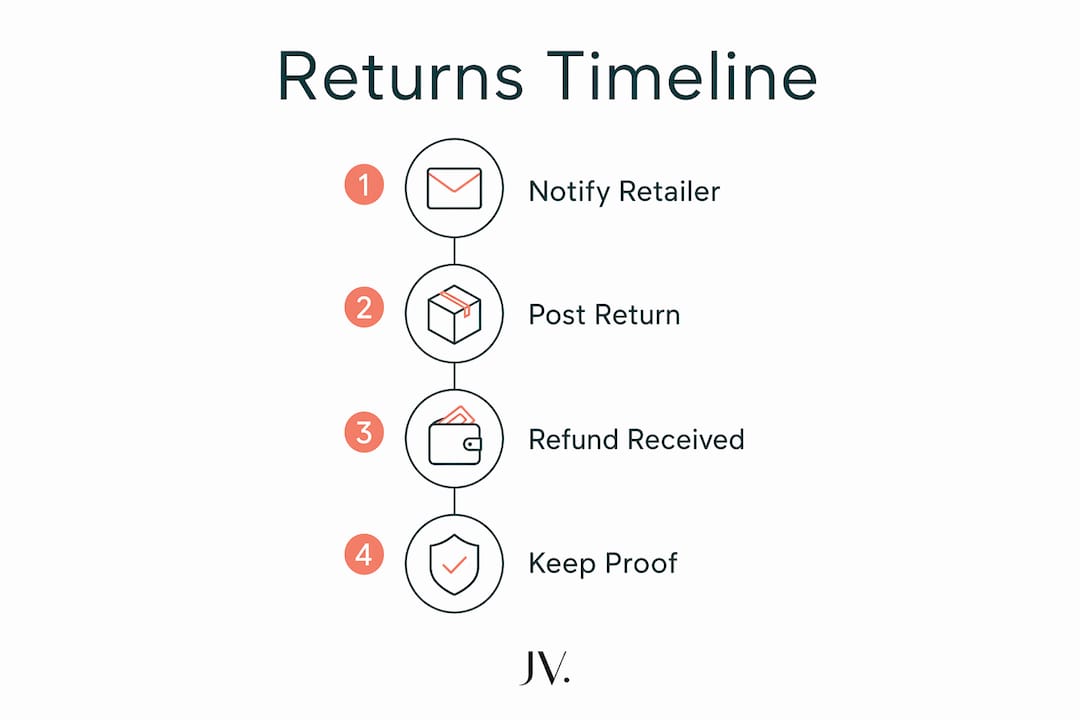
UK online shoppers have stronger legal protections than most realise when it comes to returning clothing. Under the Consumer Contracts Regulations 2013, you have a statutory 14-day cooling-off period to notify a retailer that you want to cancel, and a further 14 days after that to send the item back. The retailer must then refund you within 14 days of receiving the goods. That three-stage timeline applies regardless of what any retailer’s own policy says.
Two pieces of legislation do the heavy lifting here. The Consumer Contracts Regulations 2013 cover unwanted items bought online, giving you the right to cancel for any reason. The Consumer Rights Act 2015 covers faulty, misdescribed, or unfit goods, and applies whether you bought online or in-store. Between them, they cover almost every clothing return scenario you will encounter.
Key facts at a glance:
- You have a statutory 14-day cooling-off period to notify the retailer you want to return an item.
- You then have a further 14 days to physically send it back after notification.
- Refunds must be issued within 14 days after the retailer receives the goods.
- Faulty goods are covered by the Consumer Rights Act 2015, including sale items.
- Many UK retailers extend returns windows beyond the statutory 14 days as a goodwill gesture.
How to return clothing purchased online in the UK
The process is straightforward once you know the steps, but skipping any one of them can cost you time or money.
Step 1: Check the retailer’s returns policy first. Before you do anything else, find the returns section on the retailer’s website. Many brands, including Next, offer dedicated online returns portals where you log in, select the item, and generate a returns label. The policy will also tell you whether return postage is free or at your own cost.
Step 2: Notify the retailer within 14 days. You must tell the retailer you want to cancel within the 14-day cooling-off period. An email, a message through their portal, or a phone call all count. Keep a copy of whatever you send.
Step 3: Package the item carefully. You do not have to use the original packaging, but the item must be protected well enough to arrive undamaged. Sellers can charge you if poor packaging causes damage in transit.
Step 4: Use the correct returns label. If the retailer provides a pre-paid label, use it. A pre-paid label typically covers the value of the item if it gets lost in the post, which is a useful safety net.
Step 5: Get proof of postage. This is non-negotiable. A stamped receipt or tracked delivery confirmation shifts the burden of proof to the retailer if a dispute arises later.
- Notify the retailer in writing and keep a copy.
- Use the retailer’s official portal or contact method.
- Package items securely to avoid damage deductions.
- Always obtain proof of postage or a tracking number.
- Send the item within 14 days of notifying the retailer.
Pro Tip: Always check whether the retailer includes a pre-paid returns label in the parcel or offers one via their portal. It saves you postage costs and provides built-in cover if the parcel goes missing. For a more detailed walkthrough, see Jvwear’s guide on returning online dresses.
What are your rights when returning faulty or unwanted clothing?
Your rights split into two clear categories depending on why you are returning the item.
Unwanted items are covered by the Consumer Contracts Regulations 2013. You can return them for any reason, no questions asked, as long as you act within the statutory window. The Consumer Contracts Regulations override any retailer policy that claims to restrict or remove your right to cancel. A “no returns” notice on a website has no legal force for online purchases.
Faulty, misdescribed, or unfit items fall under the Consumer Rights Act 2015. This is a stronger protection. You are entitled to a refund, repair, or replacement, and it applies to sale items too. If you spot a fault within 30 days of receiving the item, you can demand a full refund outright. After 30 days, the retailer may offer a repair or replacement first, but your right to a remedy remains.
A few points worth knowing about faulty goods returns specifically:
- The retailer must cover return postage costs when the item is faulty.
- A credit note is not an acceptable substitute for a cash refund on faulty goods.
- Sale items carry exactly the same protections as full-price purchases.
One thing that catches shoppers out: you can try on clothing and handle it as you would in a shop, but excessive use beyond trying on can give a retailer grounds to reduce your refund. Wearing a dress to an event and then returning it falls outside what the law considers reasonable handling.
What are the key timelines and costs for UK online clothing returns?
The statutory framework sets three distinct deadlines, and missing any one of them can affect your refund.
| Stage | Deadline | Who acts |
|---|---|---|
| Notify retailer of cancellation | Within 14 days of receiving goods | You |
| Return the item | Within 14 days of notifying the retailer | You |
| Retailer issues refund | Within 14 days of receiving goods back | Retailer |
On delivery costs, the rules are specific. The retailer must refund the standard delivery cost you paid when you originally ordered. If you chose a premium or express delivery option, only the standard delivery equivalent needs to be refunded. The extra you paid for speed is not recoverable.
Return postage is a different matter:
- Return postage is usually your responsibility unless the retailer explicitly offers free returns.
- If the retailer failed to inform you who pays for return postage at the point of purchase, they must cover it.
- Faulty goods are always the retailer’s cost to return, regardless of what their policy states.
- If the retailer offers to collect the item, your refund clock starts from the day you notified them, not the collection date.
Proof of postage is your evidence that you met the 14-day return deadline. Without it, a retailer could dispute whether you sent the item at all.
Can you return online clothing purchases in-store?
Returning an online order to a physical shop is sometimes possible, but it is not a legal right. Citizens Advice confirms that in-store returns for online purchases are entirely at the retailer’s discretion. Some brands actively encourage it; others do not permit it at all.
When in-store returns are available, they come with practical advantages. You avoid paying return postage, you get an immediate acknowledgement that the item has been received, and you can often get your refund processed on the spot. Next, for example, allows online returns in-store, though their policy specifies what documentation you need to bring.
Before making the trip, check these points:
- Confirm the retailer’s policy explicitly allows in-store returns for online orders.
- Bring your order confirmation email or dispatch note as proof of purchase.
- Carry the original packaging if possible, as some retailers require it.
- Check whether the in-store return window differs from the online return window.
One practical note: if you paid via a Buy Now Pay Later provider, notify them of the return separately. Failing to do so can result in continued payments being taken even after the item has been sent back.
Practical tips for smooth clothing returns online
Most return problems come down to one of three things: missing deadlines, poor packaging, or no proof of postage. All three are avoidable.

Handle garments carefully before returning them. You are entitled to try clothing on, but wearing it beyond that risks a partial refund. Think of it as the same standard you would apply in a fitting room. If you are considering investing in quality pieces rather than returning frequently, understanding cost-per-wear can help you make better purchase decisions from the start.
Read the full returns policy before you buy. Many UK clothing return policies offer 30 days or more, which gives you more breathing room than the statutory minimum. Knowing this before you order means you are not scrambling to meet a tighter deadline than necessary.
Use the retailer’s official returns portal. It creates a timestamped record of your cancellation notification, which is exactly what you need if a dispute arises. Email works too, but a portal confirmation is harder to lose.
Track your return shipment. Basic proof of postage is free at most Post Office counters. Tracked delivery costs a little more but gives you a delivery confirmation, which is useful if the retailer claims they never received the parcel.
- Keep all packaging until you are certain you are happy with the item.
- Screenshot or print your returns confirmation immediately.
- Note the date you posted the item and keep the receipt somewhere safe.
Pro Tip: If a refund is delayed beyond 14 days, contact the retailer in writing and reference the Consumer Contracts Regulations 2013 by name. If that does not resolve it, Citizens Advice can guide you on escalating to your card provider under Section 75 of the Consumer Credit Act 1974 or via a chargeback claim.
Shop with confidence at Jvwear
Jvwear offers free UK shipping and hassle-free returns within 30 days, giving you more time than the statutory minimum to decide whether a piece is right for you. Whether you are browsing the latest women’s cardigans or picking out a new dress for the season, every order comes with the reassurance that returning it is straightforward. Shop the full collection at Jvwear and buy with confidence.
Key takeaways
UK online clothing returns are governed by two laws, and knowing both gives you full control over the process.
| Point | Details |
|---|---|
| Statutory cooling-off period | You have a legally mandated 14-day period from delivery to notify the retailer, then an additional 14 days to return the item. |
| Refund deadline | Retailers must issue refunds within 14 days of receiving returned goods. |
| Faulty goods rights | The Consumer Rights Act covers all faulty items, including sale clothing, with ongoing rights to remedy. |
| Delivery cost refunds | Standard delivery costs must be refunded on change-of-mind returns; premium delivery costs are at retailer discretion. |
| Proof of postage | Always obtain proof of postage or tracking to protect your refund rights if a dispute arises. |