The safest beach wedding guest outfit is a lightweight chiffon or linen midi or maxi paired with a grounded shoe like a wedge or a dressy flat. Fabric and footwear are the two decisions that matter most against sand, sun and sea breeze; everything else is styling. Always check the invitation for exceptions, since “beach formal” changes the brief, and browse the shop-ready looks below, including pieces from JV London, for a head start.
TL;DR:
- Choose breathable fabrics like linen, chiffon, or crepe and avoid heavy or structured materials that trap heat and resist wind movement.
- Opt for grounded shoes such as wedges or flats that distribute weight evenly on sand, and pack heels for the reception after the ceremony.
- Prioritize a well-fitted, movement-friendly dress with weighted hems or adjustable straps to prevent gusts from causing wardrobe malfunctions.
- Match pastel, sea tones, or soft prints for better photographic results, while avoiding white or busy patterns that can clash with beach backdrops.
- For heat and humidity, select waterproof, long-wear makeup and relaxed hairstyles that hold up against wind and sea breeze.
Table of Contents
- Eight shop-ready beach wedding guest outfits to copy
- Matching the dress code: casual, beach chic or beach formal
- Fabrics and fit: what survives sun, wind and salt air
- Shoes, bags and accessories built for sand
- Packing for the day-to-night swap
- Why these three JV London pieces earn their place
- Colours and prints that photograph well (and the one to skip)
- Hair and make-up that hold up in heat and wind
- Planning around heat, sun and time of day
- Gender-neutral outfit ideas for beach wedding guests
- What actually matters when you’re getting dressed for a beach wedding
- Shop the edit: wedding guest looks ready to wear
- Sources
Eight shop-ready beach wedding guest outfits to copy
Most beach ceremonies fall into three style tiers, casual, beach chic and beach formal, and the right outfit changes with each one. Here are eight looks that cover all three, with fabric, shoe and styling notes you can act on straight away.
- The barefoot casual maxi. A flowing linen maxi in a soft sea tone works for a morning or midday ceremony on sand. The Harriet oversized linen maxi dress has a relaxed slash neck that moves in the wind rather than fighting it.
- The floral statement maxi. A print maxi photographs well against blue water and pale sand. The Brina wedding guest maxi dress uses a floral print that reads polished without tipping into bridal territory.
- The draped side-slit maxi. For beach formal invites, a slit adds movement without exposing you to a gust mid-ceremony. The Tovena wedding guest maxi dress has a draped bodice that holds shape in the wind.
- The beach chic midi. Midi length suits an afternoon reception under a marquee. The Elyse lightweight summer midi dress has a deep V neck that works from ceremony through cocktail hour.
- The two-piece set. A cardigan-topped midi set gives you a built-in layer for cooler evenings, useful once the sun dips.
- The playful mini. For a laid-back, casual invite, a mini dress in a lightweight cotton keeps you cool without sacrificing polish.
- The wedge finish. Whatever dress you pick, the shoe decides whether you sink or stride. The Zelaya wedge sandals have a cross-strap design built for exactly this.
Each look pairs a breathable fabric with a shoe that won’t punish you on soft ground, which is the entire brief for beach wedding attire.
Matching the dress code: casual, beach chic or beach formal
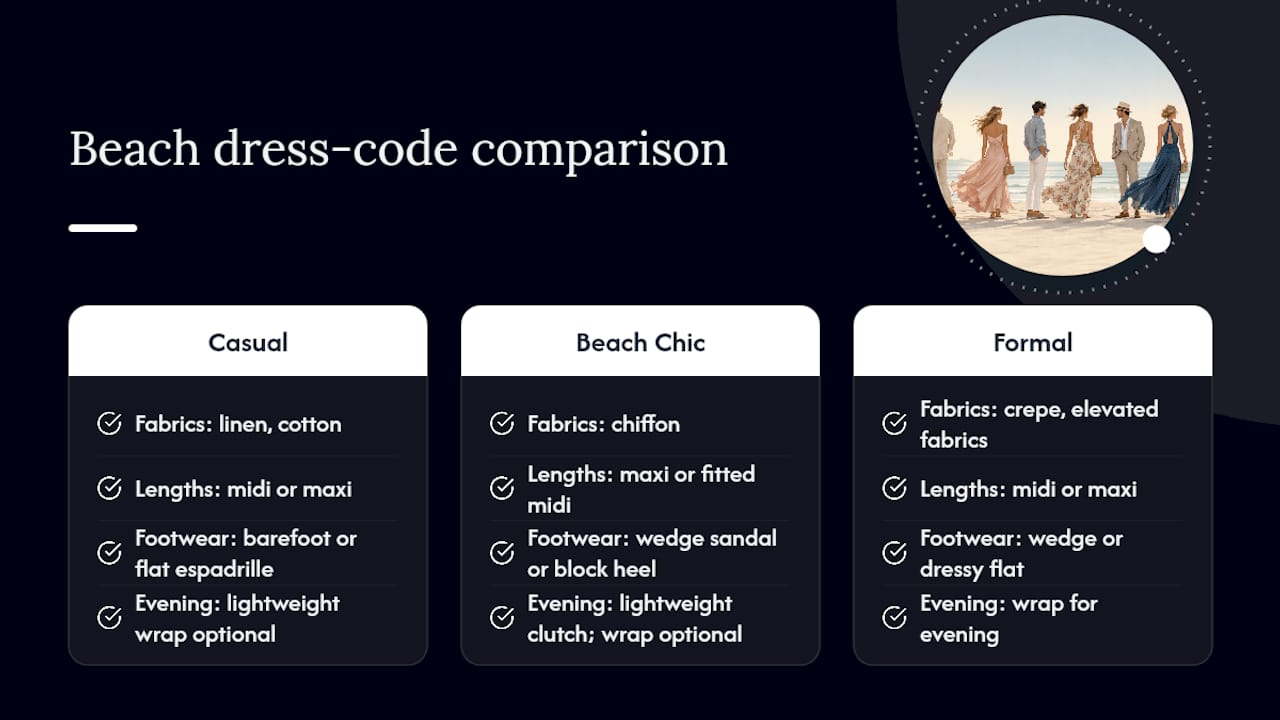
Dress codes on beach invitations tend to fall into three tiers, and each one implies a fairly specific set of fabrics, lengths and shoes. Reading them correctly means never turning up under or overdressed.
Casual (beach casual) usually means a barefoot ceremony, midday timing, and printed invitations with minimal formatting. Formulas that work: linen maxi + flat espadrille + straw tote, or cotton midi + embellished flat sandal + wide-brim hat.
Beach chic (semi-formal) signals a slightly dressier affair, often with a reception under cover. Try chiffon maxi + wedge sandal + lightweight clutch, or fitted midi + block heel + delicate jewellery.
Beach formal is the tier most guests underestimate. Even barefoot ceremonies at this level call for elevated fabrics such as crepe, plus a wedge or dressy flat rather than a casual sandal, and a wrap for evening. A reliable formula across all three tiers is a breathable midi or maxi, a grounded shoe, and a wrap you can add once the sun goes down.
Pro Tip: Study the venue photos on the wedding website, not just the invitation wording. A cliffside reception space with string lighting almost always means beach formal, whatever the invite says.
If in doubt, pack flats for the ceremony and heels for the reception rather than guessing wrong in one direction.
Fabrics and fit: what survives sun, wind and salt air
Linen, chiffon, crepe and cotton voile are the four fabrics that consistently work at beach weddings. They breathe in heat, drape rather than cling in humidity, and move with the wind instead of fighting it. Chiffon and crepe in particular photograph beautifully under bright coastal light without creasing the moment you sit down.
Avoid heavy satin, dense polyester blends and structured wool. They trap heat, show sweat, and often go rigid in salt air, which is uncomfortable by mid-afternoon.
- Choose wrap styles or fitted waists over loose, unsecured hems that catch every gust
- Look for weighted hems or lined skirts on maxi dresses to stop flyaway moments
- Pick adjustable straps so a dress that fits at 10am still fits after a beach walk
- Favour crepe over silk charmeuse if you want structure without the sweat sheen
Shoes, bags and accessories built for sand
Wedges, block heels and decorated flats are the three shoe styles that actually work on sand. Stilettos sink, twist ankles, and are widely discouraged for sand ceremonies specifically. A wedge like the Zelaya sandal distributes weight better than a thin heel ever will.
For bags, carry a small clutch or crossbody for the ceremony, then switch to something roomier for the reception if you need space for a phone, sunscreen and a lipstick.
- Wedge espadrilles or block heels for ceremony and photos on sand
- A structured tote or roomy crossbody once you reach the reception
- Sweat-proof metals, raffia or pearl accessories rather than delicate beading that salt air can damage
Pro Tip: Skip the beaded evening clutch entirely. Salt air and fine sand work into the beading within an hour, and it never looks the same again.
Packing for the day-to-night swap
Carry a labelled shoe bag with your reception heels, a spare pair of tights and a small kit for touch-ups, blotting papers included.
- Wear flats or go barefoot for the ceremony itself, saving heels for firmer ground.
- Change into your reception shoe once you’re off the sand, ideally in a restroom rather than balancing on one leg by your seat.
- Stock a small crossbody with sunscreen, hair grips and a mini brush for wind repair.
Why these three JV London pieces earn their place
Three pieces come up again and again against the formulas above: the Brina maxi for beach chic floral looks, the Tovena maxi for beach formal invites needing movement without exposure, and the Zelaya wedge for any tier where sand is involved.
- Brina: floral maxi, breathable fabric, works ceremony through reception
- Tovena: draped bodice holds shape in wind, side slit adds ease without a flash of exposure
- Zelaya: cross-strap wedge, stable on sand, dressy enough for photos
All three ship with free UK delivery and a 30-day returns window, useful if a size runs differently than expected once it arrives.
Colours and prints that photograph well (and the one to skip)
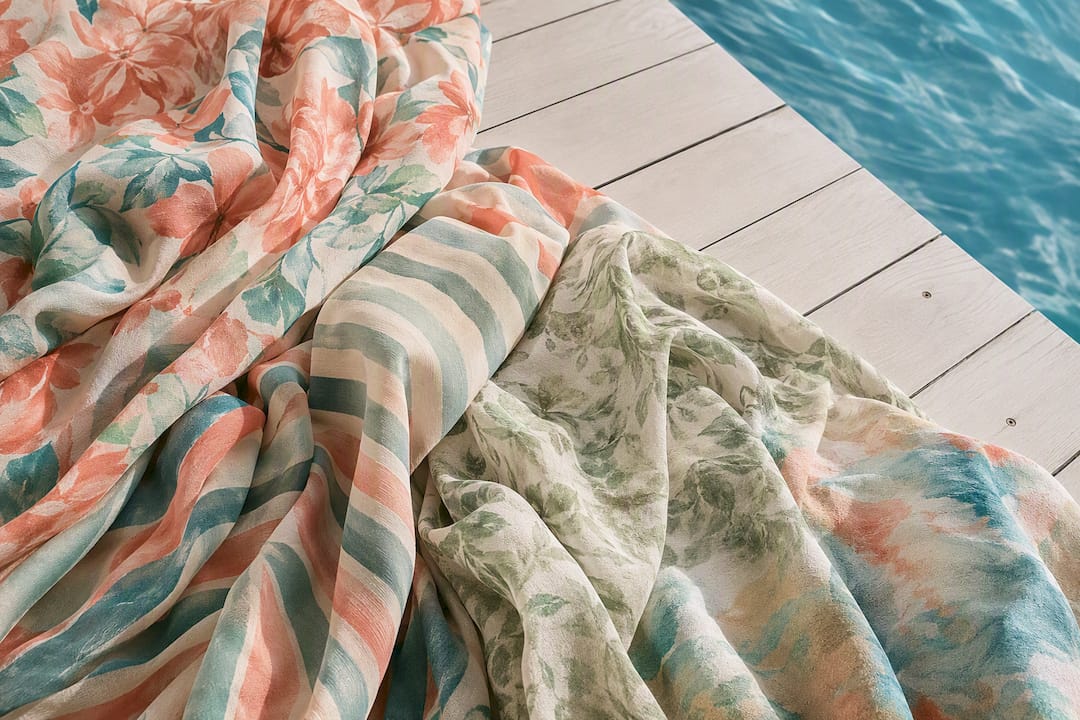
Pastels and sea tones, soft blue, sage, blush, sand and pale coral, are the colours that consistently photograph best against beach backdrops. They sit naturally alongside blue water and pale sand rather than competing with it, and they read as celebratory without upstaging anyone.
White and ivory are the one colour family to avoid outright. It’s the bride’s territory, and on a beach the confusion is worse than at an indoor venue, since sun-bleached fabric and bright light can make pale champagne or cream read as white in photographs even when it wasn’t intended to.
Prints work well too, provided they’re not too busy. A soft floral, a subtle stripe or a tonal watercolour print all photograph better than a dense, high-contrast pattern that can look chaotic against sand and sky. Bold saturated colours, coral, teal, marigold, also earn their place at a beach wedding precisely because the setting can carry them; a jewel-toned midi or maxi tends to stand out in the best way in wide shots taken during golden hour.
Black is generally fine for an evening reception but can feel heavy for a daytime ceremony under full sun, both visually and literally, since dark fabric absorbs heat fast on open sand.
Hair and make-up that hold up in heat and wind
Sea breeze and humidity are the two things that undo a beach wedding look fastest, so plan hair and make-up around them rather than against them.
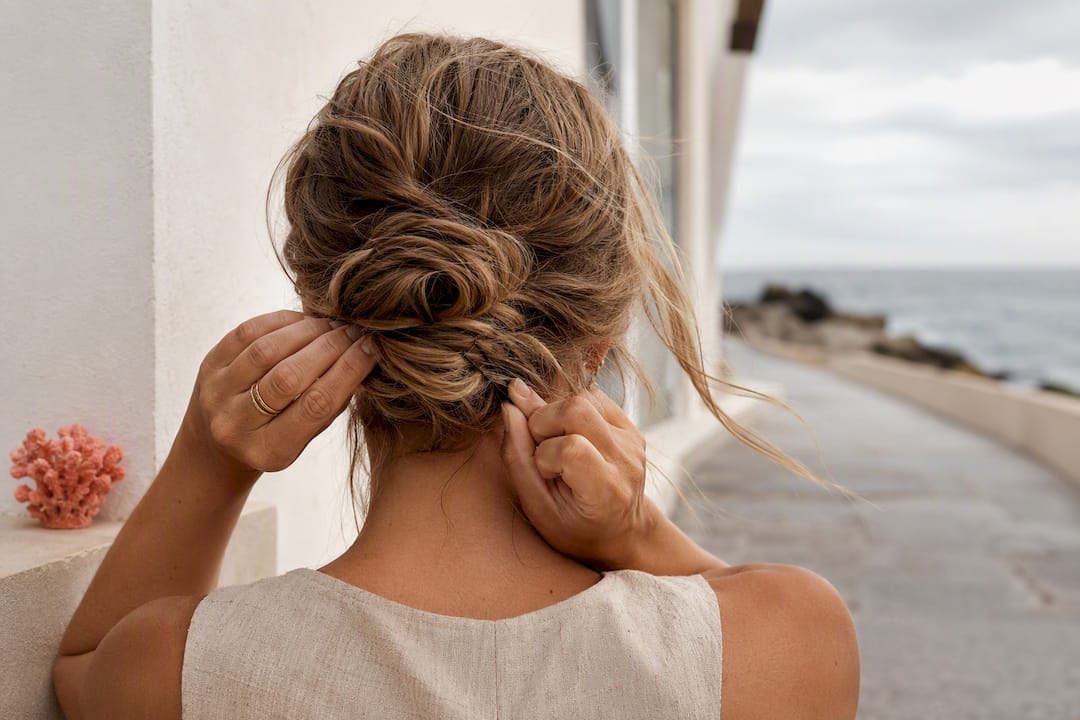
For hair, texture wins over sleekness. A loose braid, a low bun with face-framing pieces left out, or beachy waves set with a salt spray all cope better with wind than a straight, freshly blow-dried style, which frizzes and flattens within the hour. Secure any updo with more grips than feels necessary; the wind will find the weak point.
For make-up, waterproof and long-wear formulas are worth the extra minute at the mirror. A waterproof mascara and a tinted, sweat-resistant base outlast a full face of standard foundation, especially if the ceremony runs during peak heat. Cream blush and a tinted lip balm hold their colour better than powder formulas, which can shift or patch in humidity. Setting spray, applied lightly, extends everything by a couple of hours.
Skip heavy contouring and thick foundation altogether; both slide in heat and look far heavier in the bright, unforgiving light a beach setting produces.
Planning around heat, sun and time of day
The time slot on your invitation tells you almost everything about how to dress. A midday ceremony means peak sun and heat, so lighter colours, breathable fabrics and a hat or sunglasses for the seated portion earn their place. A late-afternoon or sunset ceremony is gentler on fabric choice but often windier, since coastal breeze tends to pick up as the sun drops.
Sun exposure during a seated outdoor ceremony can run to an hour or more, so factor in shade, or the lack of it, when choosing a fabric. Darker, heavier colours absorb more heat and will feel noticeably warmer by the time you’re on your feet for photographs.
Wind is the variable most guests forget to plan for. A loose maxi with an unweighted hem will fight you all afternoon, while a wrap dress or a midi with a fitted waist stays composed. If the reception moves indoors or under a marquee as the evening cools, a lightweight cardigan or wrap solves the temperature drop without needing a full outfit change.
Gender-neutral outfit ideas for beach wedding guests
Beach wedding dress codes apply just as much to guests who prefer trousers or a more tailored silhouette, and the same fabric rules hold. Linen trousers with a lightweight short-sleeve shirt cover the casual tier easily, while a linen suit in a soft neutral, worn without a tie, moves comfortably into beach chic or beach formal territory.
Footwear follows the same logic as for dresses: leather-soled shoes sink and stain on sand, so a woven loafer, a leather sandal, or a canvas espadrille performs far better and still looks intentional in photographs. A short-sleeve linen shirt with tailored shorts works well for a casual daytime ceremony, while swapping in a blazer over the same shirt lifts it to beach formal for the reception.
Colour guidance carries over too, favour sea tones and soft neutrals, skip anything close to white, and choose breathable fabric over structure every time heat is a factor.
What actually matters when you’re getting dressed for a beach wedding
Most beach wedding guides read like trend essays when what readers actually need is a decision tree.
The conventional advice oversells prints and colour palettes while undersaying almost nothing useful about fit in wind, which is the detail that actually ruins outfits on the day. An unweighted hem or a loose halter tie causes more wardrobe malfunctions at beach weddings than any colour clash ever will.
If you take one thing from this guide, prioritise the shoe. A stunning chiffon maxi paired with the wrong shoe still means sinking, limping, or removing your shoes entirely by the aisle. Get the fabric and the footwear right first, then choose colour and accessories to suit your own taste rather than a rulebook.
— Mykola
Shop the edit: wedding guest looks ready to wear
Every formula in this guide points back to the same shopping problem: finding fabric that breathes, a length that photographs well, and a shoe that survives sand. Jvwear’s wedding guest edit is built around exactly that brief, curated pieces in linen, chiffon and crepe, paired with wedge and flat sandals that were chosen with sand in mind, not just a studio floor.

If your invite leans casual, the Eden casual summer dress is a fast, no-overthinking pick. For beach chic or beach formal, the Solvra two-piece midi dress set gives you a matching cardigan for the evening drop in temperature, and a cardigan from the layering edit covers anyone whose dress doesn’t already come with one. Every order ships free within the UK, with a straightforward 30-day return if the fit isn’t quite right once it arrives. Browse the edit, pick your fabric, and get the shoe sorted before the invite deadline creeps up on you.
Sources
- What to Wear to a Beach Wedding - The Knot
- Beach Wedding Guest Dress Guide: What to Wear in 2026 | Klodsy